Feeds:
Posts
Comments

Posts Tagged ‘recipe’

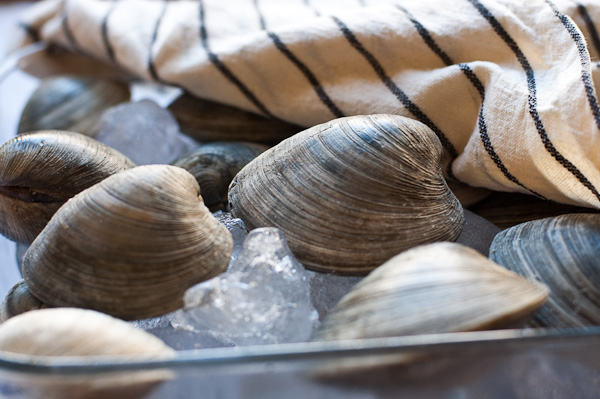
Littleneck clams chilling out

This article is part of a series of recipes suitable for the Medieval season of Lent during which all animal products other than fish were forbidden except on Sundays. I’ll be posting at least one Lenten recipe per week until Easter Sunday (April 4, 2010).

When searching for Lenten recipes it seems natural to explore the traditional foods of countries with a long Christian tradition. One of the first that comes to mind is Italy, which is particularly useful because the cooking fat of choice in most of its regions is olive oil rather than butter, which meshes very easily with the strictures of Lent. The coastal areas of Italy are a rich source of seafood and shellfish recipes which often do not need to be changed at all. Today’s dish has the added joy of combining clams from the Adriatic sea with peas, giving us a little taste of spring before it fully arrives.

Clams spawn from April until October. Besides the fact that it is not sustainable to eat an animal during its breeding season, shellfish doesn’t taste as good during spawning. So the best time to eat them is from November through March. Depending on when Easter falls (it is calculated using lunisolar cycles and so changes each year) clams are tasty throughout most of Lent.

I prefer to cook as seasonally as I can. Using things only when they are at their peak increases our appreciation of them. For example, every year I look forward to tomato season, that brief time of juicy abundance when all I need to make an amazing meal is a little sea salt and olive oil, and maybe some bread and good mozzarella di bufala. However, I do make a few exceptions, one of which is frozen peas. They are flash frozen at the moment of harvest and so in a sort of time shifted way, they are in season when you pull them out of the freezer. Especially at the clinging end of winter I find peas particularly uplifting, giving me just a hint of the green I long for. The chopped parsley in this dish is also key. Be sure to buy very flavorful, dark green, flat leaf, Italian parsley. I was surprised at how the flavor reminded me of the baby lettuces we’ll soon be seeing in the market.

This soup is both briny and green, like a fresh sea breeze blowing through a fresh meadow, a much needed tonic at the end of winter.

Don’t be intimidated by cooking shellfish at home. Really, it’s not as hard as you think. Here are some important things to remember:

1. The clams must be fresh. They will keep for 1 day in the refrigerator, but really you should cook them the same day you buy them. If you need to store them, fill a baking dish with ice, put the clams on the ice, cover the dish with a clean wet kitchen towel, and place the dish in the refrigerator. Check the dish towel occasionally to be sure it is still wet. Do not seal clams in plastic, they are alive and need to breathe.

3. Inspect your clams carefully before cooking. They should all be firmly closed, or they should close up when you tap the shell. If a clam stays open, discard it.

4. Before cooking, scrub the outside of each clam well with a stiff brush under running water. Next, soak your clams in a bowl of water for about an hour. As they “breathe” they expel any sand that may be inside them. When finished soaking, remove the clams from the bowl carefully so as not to disturb any sand which will have fallen to the bottom of the bowl. Finally, rinse the clams one more time in fresh water, scrubbing once more with the stiff brush. Now they are ready for the pot.

Clam and Pea Soup

Adapted from Marcella Hazan

Serves 6

3 dozen littleneck clams, scrubbed and soaked (see above)
3 pounds frozen peas, thawed
1/3 cup olive oil
1 small onion, chopped
3 cloves garlic, chopped
4 tablespoons chopped Italian parsley
2/3 cup canned plum tomatoes, chopped, with their juice
salt
freshly ground black pepper
Crostini (optional, see recipe below)

Put your scrubbed and soaked clams in a large enough pot for them to be layered no more than 2 or 3 deep. Add 1/2 cup of water, cover and place the pot over high heat. About every 30 seconds, pick up the whole pot, and shake it while holding the cover on. If the pot is too heavy for you to do this easily, you may instead quickly take off the lid and stir the clams with a spoon, but replace the lid as soon as possible to keep too much steam from escaping. The goal is the move the clams around as they are cooking so they are all exposed to the heat evenly. After 3-5 minutes some of the clams will begin to open. Use tongs to remove the clams as soon as they open and place them in a bowl. Continue shaking or stirring every 30 seconds until all of the clams are open. In the unlikely event that you have a clam or two that doesn’t open even after a total cooking time of 10 minutes, discard them. They are most likely full of mud and sand, and you wouldn’t want to eat them.

When all of the clams have been removed from the pot, turn off the heat and tightly cover the pot.

Once the cooked clams are cool enough to handle easily, remove the meat from the shells and chop each clam into 3-4 pieces. Place the clam meat in a bowl and pour any liquid that has accumulated in the bowl where the clams were cooling back into the pot.

Line a fine mesh strainer with paper towel and pour the clam cooking liquid through it into a bowl, removing any sand and grit. Pour just enough of the strained liquid over the chopped clam meat to keep it moist and reserve any remaining clam cooking liquid for later use.

Add the olive oil to a large deep saute pan and place it over medium heat. Saute the onion until it is translucent, add the garlic and cook until it turns golden brown. Add the half of the chopped parsley (2 tablespoons), and the tomatoes with their juice. Season with a large pinch of salt and a couple of grinds of fresh black pepper. Turn the heat down, and simmer partially covered for 10 minutes to combine the flavors.

If you are serving the soup with crostini (see recipe below), this is a convenient time to make them, while the soup simmers a bit.

Add the thawed frozen peas, any reserved clam liquid and if necessary, enough water to cover the peas by about 1 inch. Cover the pot and cook for 1-2 minutes at a gentle simmer. Don’t over cook the peas, you don’t want them mushy. Taste the soup and correct the seasoning with salt and pepper if necessary.

Add the cut up clam meat and its juices. Cook just enough to warm the meat through, barley a minute or so. Be careful not to overcook here, as the clams will be come tough very quickly.

Ladle the soup into bowls, add crostini, if using, and sprinkle with the rest of the chopped parsley.

Crostini

Adapted from Marcella Hazan

Serves 6

6 slices of good white bread
olive oil

These should be made as close to serving time as possible. They will keep at room temperature for a couple of hours but no more than that.

Cut the crusts from your bread and cut it into 1/2-inch squares.

Put enough olive oil in a medium skillet to come 1/2 inch up the side of the pan. Put the skillet over medium-high heat and heat the oil until it is hot enough to make the pieces of bread sizzle (test by putting just one piece in, if it’s not time, remove it and wait a little longer).

Once the oil is hot enough, put in as many bread squares as you can without crowding the pan and turn the heat down to medium. Scoot the bread pieces around the pan with a spoon and turn them over in the oil so both sides brown evenly. Cook them until they are a light golden brown, then remove them with a slotted spoon to a plate with paper towels to absorb any excess oil. Store at room temperature until serving time.
Read Full Post »

Photo by Sandor Weisz

“Is Slow Food Really Slow?” is a series here on Comestibles in which we explore the hypothesis that some of the processes many modern home cooks have declared too time consuming are a lot easier than the admen would have us believe.

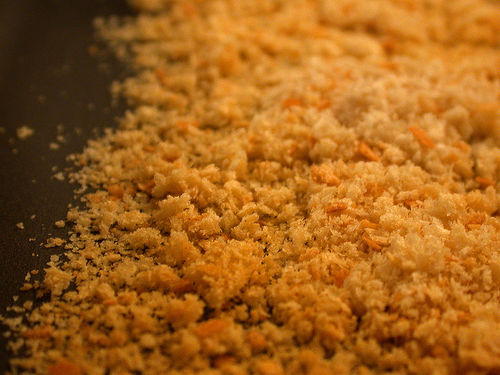
Did you know there are 31(!) ingredients in the plain breadcrumbs sold at the grocery store? Really, have a look next time you’re shopping.

There is no reason to ever buy breadcrumbs. Have you ever thrown away the heel of a loaf of bread because it’s too small to make a sandwich or because you just don’t like the heel? Or, have you forgotten you have some bread in the house, only to discover a week later that it has gone completely stale? Have you ever bought some really cheap, nasty, industrial, squishy bread because the only store open was the corner bodega and you were desperate, but now that you’ve eaten two slices you regret it? In all of these situations you might end up throwing the bread away, what else can you do? Make breadcrumbs!

I will confess that the Panko or Japanese-style breadcrumbs sold in stores these days are very nice. They only have 5 ingredients, are perfectly uniform and super crunchy, and I feel like a celebrity chef when I use them. But when I think about how they came to be so perfect, I get visions of factories in my head. My big reasons for making my own breadcrumbs (besides the fact that I’m a geek) are to prevent food waste, cut down on the number of containers I have to send to the landfill and keep unnecessary and possibly unhealthy ingredients out of my food. It seems ridiculous to pay a company to pulverize bread and toast it in a factory somewhere and then ship it to a store so I can buy it when I can make the same thing in about half an hour at home.

There are two types of breadcrumbs fresh (sometimes called moist), and dry. The dry ones are crunchy and are mainly used in recipes as a coating or topping. Fresh breadcrumbs are also made from stale bread but they are not toasted so they remain softer. Fresh breadcrumbs are used for stuffing or as a filler to bulk out meat preparations and sauces. You may not get the same even browning from homemade dry crumbs as you do from the store bought kind, but I think that makes dishes look more homemade. The commercial crumbs often have some dried milk or egg in them, if you want to experiment you could try adding some powdered milk. I imagine the milk proteins would help the browning.

Breadcrumbs Fresh or Dry

Approximately 4 slices of bread makes 1 cup of breadcrumbs

Any kind of stale bread, dry but not rock hard, and certainly not moldy.

If your bread isn’t stale, put the slices in a 350F oven for 5 minutes or so to dry it out, but don’t let it brown.

Tear your bread into 1 inch pieces and process in a food processor or blender until you have the size breadcrumbs you wish. If you don’t have a food processor you can grate the bread on a box grater or put the dry bread in a bag and crush it with a rolling pin.

These are fresh or moist bread crumbs. They can be stored in the freezer in a zip top bag until you need them.

If you want to make dry bread crumbs preheat your oven to 350F and spread your fresh breadcrumbs in a single layer on a sheet pan. Bake them in the oven for 10 minutes. Then stir the crumbs to ensure even crisping and bake for an additional 5-10 minutes. You don’t want to brown the crumbs very much since you’ll likely be using them as a coating or topping where they will be cooked further. Just dry them out until they are crisp and crunchy.

Store in a zip top bag in the freezer until needed.

Variations: If you want to duplicate the “Italian style” breadcrumbs sold in stores, mix in some salt and dried herbs such as basil, and oregano.

Read Full Post »

This article is part of a series of recipes suitable for the Medieval season of Lent during which all animal products other than fish were forbidden except on Sundays. I’ll be posting at least one Lenten recipe per week until Easter Sunday (April 4, 2010).

I had no idea the Greeks ate pasta. According to Vefa Alexiadou, Greece’s version of Irma Rombauer, pasta has been a staple in some regions of that ancient land for centuries. Her cookbook, Vefa’s Kitchen, is packed full of fascinating tidbits like that, including lots of information about the different regions of Greece and their cultural history. As you might expect in a country with a tradition of Orthodox Christianity, there are many Lenten recipes. Some of them, like today’s, even identify themselves as such in their titles.

Sticking to the Medieval rules of Lent can be a challenge. One of the biggest things I notice every year is the drop in the amount of protein I’m eating. The brain needs protein to function well and during the first few days of Lent I often find myself a little distracted and unable to concentrate. As a former vegetarian, I know I don’t need meat and other animal products to get all the protein I need, I just have to think a little differently about what to eat. Lenten Spaghetti with Tahini is the perfect solution to this problem. The sauce is based on tahini, a roasted sesame paste common in middle eastern food, and the protein content is augmented further with a sprinkling of ground walnuts and toasted sesame seeds.

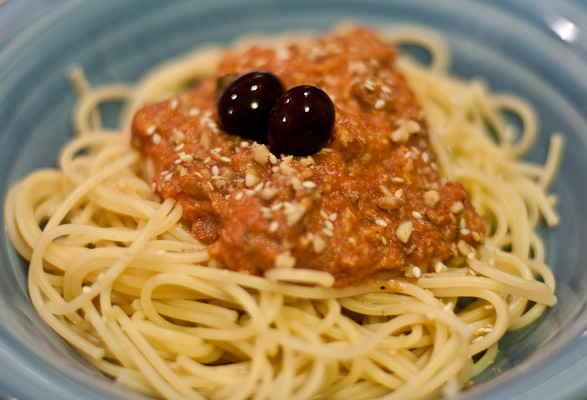
This dish is surprisingly light with bright, almost summery flavors provided by the mint, along with an unusual medieval zing from the allspice and cinnamon. I was skeptical about the olives, but they bring just the right amount of salt and earthiness. Eating this had me dreaming of warm weather and outdoor cafes. A ray of sunshine in the darkness of Lent

Lenten Spaghetti with Tahini

Adapted from Vefa Alexiadou

Serves 4

4 tablespoons tahini
1 medium onion
15 oz. canned chopped tomatoes
1 tablespoon balsamic vinegar
1 tablespoon tomato paste
8 whole allspice berries
1 bay leaf
1 good pinch of ground cinnamon
4 tablespoons finely chopped fresh mint
1/2 teaspoon sea salt
freshly ground black pepper
2 tablespoons olive oil
1 pound spaghetti
3/4 cup ground walnuts
4 tablespoons sesame seeds
10 Kalamata olives, pitted

Peel the onion and grate it either in a food processor or with a hand grater. Put the grated onion in a medium saucepan with the tahini and cook over medium heat for about 5 minutes, stirring constantly, until the onion is soft. Add the tomatoes, vinegar, tomato paste, allspice berries, bay leaf, cinnamon, mint, sea salt and a few grinds of black pepper.

Simmer the sauce, uncovered for about 15 minutes to combine the flavors. The consistency should be that of a light meat sauce. If it seems too thick, feel free to add a bit of water.

As the sauce simmers, put a large pot of salted water on to boil, adding the 2 tablespoons of olive oil to it to keep the pasta from sticking. Lightly toast the sesame seeds in a dry skillet by stirring or shaking constantly over a medium-high heat until they begin to brown. Be careful, they can burn very easily.

Cook the pasta to your taste using the package directions. Taste the sauce and season further with salt and pepper if necessary. When the pasta is cooked, drain it and toss with the sauce in a large bowl. Sprinkle the individual servings of pasta with the ground walnuts and toasted sesame seeds, and garnish with Kalamata olives.

Read Full Post »

Photo by Javier Lastras

It was a brave woman, who decided to taste the strangely thickened stuff that appeared in her milk container one day. I wonder how our early ancestors figured out the difference between “spoiled” milk that was safe and even good for you, like yogurt, and the kind that can kill you? Sounds like a dangerous game to me.

Yogurt seems to have originated in Central Asia at least 4,500 years ago. No one knows how it was created the first time, but it was most likely an accident. With no refrigeration, milk was something that had to be consumed as soon as it was drawn from its animal source. This was true even during the cooler seasons of the year because with no pasteurization, milk is a prime medium for the growth of undesirable bacteria that can kill. However, some of the bacteria floating around can have a good effect when they colonize our food. Think about the wild yeast beers made in Belgium, or those fabulous French cheeses. Along with yogurt, these foods were likely discovered by accident when wild bacteria came to call. The creation of yogurt and cheeses allowed us to preserve milk for a little longer, a real boon to ancient nutrition, not to mention, tasty.

Humans are supremely adaptable, and after a while we figured out how to ensure the good kind of “spoiled” milk every time we tried to make it. Lucky for us, we don’t have to do this through trial and error they way our ancestors did, we’ve got science! Yogurt is milk that has been cultured with two (and sometimes more) bacteria, Lactobacillus bulgaricus and Streptococcus thermophilus. When they colonize milk they convert the milk sugars into lactic acid lowering the pH of the milk. Most “bad” bacteria cannot grow in an acid (low pH) environment, so these little guys are protecting us by preventing nasty things from growing. Another benefit provided by our little friends, is that breaking down the milk sugars makes yogurt very easily digestible, even by people who are lactose intolerant. In fact, this is one of many reasons to make yogurt at home. Often commercial brands of yogurt contain added milk solids as a thickener which may not be tolerated if you have trouble digesting lactose. If you make yogurt at home, you can avoid this.

Yogurt making consists of four steps: scald your milk and then allow it to cool to 115F; add your yogurt starter; incubate your yogurt; and then refrigerate. Originally, the milk was probably scalded to kill the bad bacteria; these days we have pasteurization for that. However, you’ll notice that most yogurt recipes still have you heat the milk first. Why? The scalding process starts to unfold the milk proteins and when they refold during fermentation they form tighter bonds, resulting in a thicker, firmer finished product and less whey separation. You can make yogurt without heating your milk and in fact, proponents of raw milk do just that when they make raw milk yogurt.

In an attempt to simulate the original yogurt made in Central Asia eons ago, I used a very simple recipe containing just whole milk and a starter, nothing else. You can use any kind of milk you like and if you want a quick way to ensure very thick yogurt you can add powdered milk, which is essentially milk solids. As a starter, I used a few tablespoons of a commercial brand of whole milk yogurt that does not have any thickeners or stabilizers in it. Not all commercial yogurt is created equal, so read the label. You want to make sure your starter has active cultures in it. If it doesn’t say “contains active (or live) cultures” on the label then they’re not in there. You can also buy dried yogurt starter from a cheese making supply company.

Once you start making your own yogurt, you can do what our ancestors did and use a bit of your last batch to make the next one, just like with sourdough bread. If you choose to use the self-perpetuating method, the easiest way to ensure an uncontaminated starter is to make two containers of yogurt each time. One large one for the yogurt you will be eating and one small one (about 4 oz.) to create the starter for your next batch. That way the starter jar stays closed and uncontaminated until you use it to make your next batch.

Once you’ve blended the starter with the warm milk, pour the milk mixture into a sealable storage container and put it in a warm place to incubate. Ideally, the temperature needs to be around 110-115F (43-46C). But beware, you do not want the temperature to climb above 120F (48C), this will kill off our friendly little bugs. I have found success by putting my quart mason jar of yogurt in a cold gas oven with the interior light bulb left on. Other methods I have heard about include using a heating pad inside a container big enough to hold your yogurt jar, or a small enclosed space with a clip light and a 100 watt bulb. Experiment until you find a good incubation place in your home for yogurt.

How long to incubate is up to you, the longer you go, the thicker and tangier it gets. For medium thickness and flavor, try 6 hours of incubation. I like my yogurt thick so I leave it for 12-15 hours. When it has finished incubating to your satisfaction, put it in the refrigerator over night to stop the fermentation process and set the texture. If you like a super-thick Greek-style yogurt, you can strain the finished product through several layers of cheese cloth.

Homemade Yogurt

1 quart whole milk of the best quality, organic preferred
3-4 tablespoons whole milk plain yogurt with live active cultures, room temperature
1 quart sized container with a sealable lid
1 digital probe thermometer

Sterilize your jar and lid in a 225F (107C) oven for 5 minutes and then remove them and allow them to cool.

Over a medium-low burner, heat the milk to 180F (82C) and then take it off the heat and allow the temperature to drop to 115F (46C).

Mix the whole milk plain yogurt into the cooled milk. Be sure to whisk thoroughly; you want those friendly bacteria to be evenly mixed into the milk.

Pour the milk mixture into your sterilized 1 quart jar, leaving an inch or so of room at the top. Close tightly and place it in your cold oven with the lightbulb turned on inside or some other suitably warm place in your home (see above for suggestions). For mild flavor and medium thickness incubate for 6 hours, if you like your yogurt thicker and tangier you can leave it for 12-15 hours

When incubation is complete, move the yogurt to the refrigerator and chill for 24 hours. Serve plain or with fresh fruit and/or honey.

Read Full Post »

This article is part of a series of recipes suitable for the Medieval season of Lent during which all animal products other than fish were forbidden except on Sundays. I’ll be posting at least one Lenten recipe per week until Easter Sunday (April 4, 2010).

Asian cuisine is a tremendous source of Lenten dishes. There are many fish-based and vegetarian delights to choose from. These recipes often contain no dairy, or what there is can easily be replaced with olive or other oils. Best of all, this food is flavorful and exotic so you don’t feel like you’re denying yourself. In fact if you save these dishes especially for Lent, it can feel like a celebration.

Lately I have been infatuated with Fuchsia Dunlop’s magnificent Chinese cookbooks. Today’s recipe is a savory, spicy (but not too hot) fish dish from Sichuan province. It does require some specialty ingredients, but if you live near a chinatown this can be easily accomplished. There are also good mail order sources for much of what is needed (see recipe below for details).

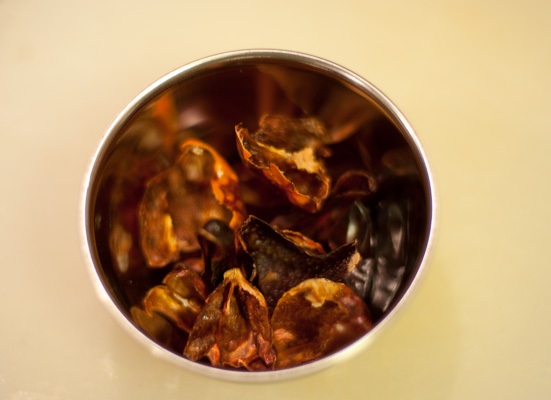
Facing-heaven chiles, waiting to go into the wok

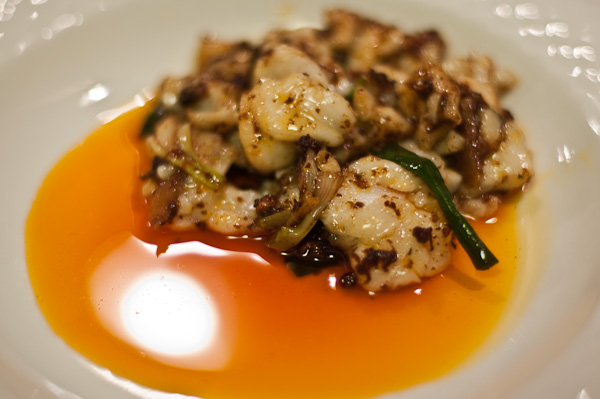
Don’t be intimidated by the bright red oil that drenches the fish. It’s purpose is to stimulate your senses with it’s deep color and spicy, almost floral fragrance, you are not expected to eat it. Take the fish out of of the oil with your chopsticks, leaving most of it behind on the plate, along with the whole spices which have also already done their job.

If you haven’t eaten Sichuan food before, know that while it is spicy, it is not as fire engine-hot as you might expect. One of the most important ingredients is Sichuan pepper which is not at all spicy, but instead causes a physical sensation of numbness and tingling in the mouth. It is very sensuous and pleasant, and really makes this cuisine special.

Fish with Chiles and Sichuan Pepper

adapted from Fuchsia Dunlop

Serves 2 as a main dish if served with a vegetable side dish and rice

Notes on specialized ingredients:
If you live in New York City, see my previous article about shopping for sichuan ingredients in Chinatown. There are also photos there of whole facing-heaven chiles and Sichuan pepper so you’ll know what to look for. Unfortunately, I have not found a good mail order source for the facing-heaven chiles so if you don’t live near a chinatown you may need to substitute. I have read that pequin chiles can be used, but the flavor is not the same. Beware, if you use the long skinny Thai chiles (also called bird’s eye chiles), they are much hotter than Sichuanese chiles so you should use less.

I can highly recommend the Sichuan pepper available via mail order from Adriana’s Caravan, it is very fresh and flavorful. They also carry the chili bean paste, which they call Chili Bean (Toban Djan) Sauce. When shopping for this item try to get a version made with fava or broad beans instead of soy beans.

1 pound filet of carp, sea bass, or other white-fleshed fish

For the Marinade
a 1-inch piece of fresh, unpeeled ginger, crushed
1 scallion, both white and green parts cut into 3-4 pieces and crushed
½ teaspoon salt
2 teaspoons Shaoxing rice wine or dry sherry
4 tablespoons cornstarch
3 tablespoons cold water

For the Base Flavorings
6 dried Sichuanese chiles (facing-heaven chiles)
1 1-inch piece of ginger, peeled and thinly sliced
3 cloves of garlic, peeled and thinly sliced
5 scallions both the white and green parts, cut into 2-3 inch pieces and crushed
3 tablespoons of peanut or corn oil
1 tablespoon Sichuanese chili bean paste
1/2 teaspoon whole Sichuan pepper

For the Spicy Oil
¾ cup peanut or corn oil
1½ tablespoons Sichuanese chili bean paste
1-2 ounces dried Sichuanese chiles (facing-heaven chiles)
2 teaspoons whole Sichuan pepper

It is important to measure and chop all of your ingredients before beginning this dish. Once you start cooking it goes very quickly, so have everything prepped in small containers and ready to go.

Marinate the fish: lay your fish fillet on a cutting board and cut it into ¼-½ inch thick slices by holding your knife almost parallel to the cutting board and making very shallow cuts. Put the slices in a small bowl and add the salt, wine or sherry, ginger, and scallion, and toss gently with your fingers. Let stand while preparing the rest of your ingredients.

Snip all of your dried chiles in half with scissors and shake out as many seeds as possible. If you have sensitive skin you may want to wear gloves. In any case, wash your hands thoroughly with soap after handling the chiles and be careful about touching your eyes.

Cook the base flavorings: heat 3 tablespoons of oil in a wok over a high flame. When it begins to smoke, turn the heat down and add the chile bean paste and stir-fry until the oil is red and fragrant. Add the ginger, garlic, scallions, dried chiles, and Sichuan pepper and continue to stir-fry until it is very fragrant and the scallions are tender. Keep an eye on the temperature, you want the oil sizzling but not so hot that it will burn the spices. Pour the contents of the wok into a deep serving bowl.

Cook the fish: bring a medium saucepan full of water to a boil over high heat. Meanwhile, discard the ginger and scallion from the fish marinade. Mix the cornstarch and cold water to form a thin paste. pour the paste over the fish slices and toss gently with your fingers until all of the slices are well coated. When your water is boiling, drop all of your fish slices into the pot. DO NOT stir until the water has returned to a boil or the coating will come off. Allow the water to come back to a boil and cook the fish slices until they are just done and nicely flaky (about 5 minutes). Use a slotted spoon or skimmer to remove the fish slices from the pot and put them in the serving bowl on top of the base flavors.

Make the spicy oil: Quickly heat ¾ cup of oil in the wok over a high flame until it begins to smoke. Turn down the heat a little and add the chili bean paste and stir-fry until the oil is red and fragrant. Add the remaining chiles and whole Sichuan pepper and stir-fry until they are crisp and fragrant, the longer you go, the spicier it gets. The oil should be sizzling but not so hot as to burn the spices. When it is ready, pour the hot oil and spices over the fish in the serving bowl and serve immediately while it is still bubbling.

Read Full Post »

No matter where you live or what you call it, the object of the last day before Lent is the same: eat as much of the soon-to-be-forbidden foods as you can before it’s too late. Lent, which begins this year on Wednesday, February 17th, is a 40 day season during which Christians traditionally fast, pray, and give alms to the poor. In the Medieval period, observant Christians were forbidden meat, milk, eggs and animal fats during Lent. The modern Catholic church has eased these rules, encouraging voluntary fasting and abstinence. This is defined as eating only one full meal per day (or two small ones which add up to less than one full meal), and the omission of meat and poultry on Ash Wednesday (the first day of Lent), and all the Fridays in Lent. It has also become traditional for people to give up something they particularly enjoy for the 40 day period, although that is not an official church policy.

As you might imagine, the Medieval rules led to lots of serious eating during the days leading up to Lent. Aside from having one last taste of your favorites, you needed to use up all the eggs, milk, and animal fats in the house. In the days before refrigeration, using up the meat was not as much of an issue because it was only acquired right before it was to be eaten, so most households didn’t have a lot lying around.

In particular the very last day before Lent is a great excuse for wild parties; in Iceland they call it Sprengidagur which means Bursting Day; the French name for it is Mardi Gras or Fat Tuesday; in Sweden it is Fettisdagen; in Estonia, Vastlapäev; in Spain, Martes de Carnaval; in the Czech Republic, Masopust, which means “goodbye to meat,” and in German, Faschingsdienstag. In English-speaking countries it is known as Shrove Tuesday, Pancake Tuesday, or simply Pancake Day. The word “shrove” comes from the archaic verb “to shrive” which means to obtain absolution for your sins. It was important to be shriven before the beginning of Lent as it is a season of penance.

Even though the rules are no longer as stringent, this religious tradition has left us with some wonderful seasonal foods. Since their purpose was to use up all of the non-lenten ingredients in the house, they have some things in common. They are often fried and they are very rich, containing eggs, milk, butter, and if a creative cook can manage it, some meat thrown in for good measure.

In Portugal they make Malasada which is a fried dough; the Polish enjoy their Paczki or jelly doughnuts; in Sweden you would be eating Semla, a pastry spiced with cardamom, filled with almond paste and whipped cream, and served in a bowl of hot milk; in Croatia, which was part of Venice for hundreds of years, they eat Fritule which are fritters enhanced with brandy and lemon zest; and the denizens of the Czech Republic say “farewell to meat” by holding large pork feasts during the time leading up to Lent.

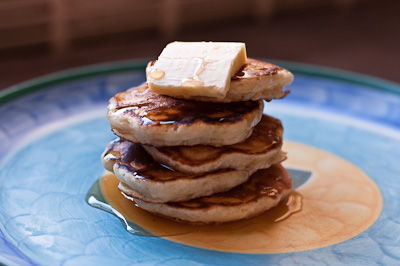
In English-speaking countries the traditional Shrove Tuesday meal is pancakes, they can be made either savory or sweet and are a great way to use up eggs, milk, butter and other fats. Traditionally in Britain they were served with a rich meat stew. In some places slices of sausages or other meat are mixed right into the pancake batter. Try out the recipe below and imagine, if you will, Medieval British cooks flipping their pancakes while keeping one ear cocked to hear the the ringing of the shriving bell or pancake bell which reminded them to use up all their fats and come to church to be shriven.

Pancakes

Adapted from The Joy of Cooking

Makes about 14 four inch pancakes

1½ cups all purpose flour
1 teaspoon salt
3 tablespoons sugar
1¾ teaspoons baking powder
2 eggs, separated
3 tablespoons melted butter
1¼ cups milk, or buttermilk

Stir together the dry ingredients with a fork. In a separate bowl, beat the egg yolks and the milk or buttermilk together, then stir in the melted butter.

Pour the eggs and milk into the bowl with the dry ingredients and stir only enough to just wet all the dry ingredients, don’t beat too much; you want it to look lumpy. It should be thick but still pour fairly easily off a spoon. If it is too thick add a bit more milk or buttermilk and if it is too thin add more flour.

Whip the egg whites until they form stiff peaks and then fold them lightly into the batter, taking care to deflate them as little as possible.

If you cook the pancakes on a non-stick surface you won’t need any butter. If you use a regular pan then use just a little butter to keep them from sticking.

Heat the pan over medium-high heat until water splutters when a few drops are sprinkled on it.

Use a large spoon to transfer the batter to the pan. Don’t drop it from way up high, just let it pour from the tip of the spoon onto the pan, this will help control the pancake shape. Once you have formed the pancake let it cook for 2-3 minutes or until most, but not all, of the bubbles which form on the uncooked side have burst. Then flip the pancake and cook the other side for 1-2 minutes or until nicely browned.

Break open your first pancake to see if the inside is cooked properly and adjust the heat under your pan accordingly, then continue making pancakes until all the batter is used up.

To keep the pancakes warm before serving, keep them on a plate in a warm oven separated by clean kitchen towels. Without the towels between them they will steam each other and lose their nice texture. You can prepare a stack of folded kitchen towels in advance and put on pancake in each layer.

Read Full Post »

Making ricotta is sort of like getting into the union. You must already have a union job before you can get into the union and in order to make true ricotta you must already have made some cheese. Real ricotta is a dairy product (technically it is not a cheese) made from whey. Whey is a byproduct of cheese making; in particular, ricotta is made from the whey left over after making pecorino, an Italian sheep’s milk cheese.

To make true ricotta, the fresh whey is left to stand for 12-24 hours which increases its acidity. It is then heated to a temperature very close to boiling. This causes any remaining protein to coagulate into very fine curds which are skimmed off, drained through some cheese cloth, and allowed to cool.

We don’t really know how long people have been recycling left over whey into a secondary product. Some argue that it is mentioned by Cato the Elder in his De Agri Cultura which was written around 160 BCE. Others claim that the Arabs brought the technique to Europe when they conquered Sicily in the 10th Century.

As usual, our ancestors knew a good thing when they saw it. Whey is packed with important nutrients including protein and riboflavin (vitamin B2). In fact, the Vikings used to drink whey and use it for pickling fish and vegetables. Its acid nature makes it a great pickling agent. Other uses for whey include: replacing the water in any bread recipe, or buttermilk in other baking recipes; feeding it to farm animals, pigs in particular, love it; seasoned with spices it can be used to marinate meat; or pour it on your garden as a fertilizer. Modern dairies often send their whey to be dehydrated and used as a component in the various protein powders favored by body builders.

Even if you don’t have your cheese maker’s union card, you can still make ricotta (or something similar) at home. You just need good whole cow’s milk, salt and citric acid. Citric acid is a crystalline substance that looks a lot like sugar, but tastes like a thousand lemons. If you’ve ever tasted Sour Patch Kids or other super sour candies, you’ll recognize the flavor. Citric acid is sometimes called “sour salt” and can be easily purchased in stores which specialize in Indian ingredients because it is used to make paneer. You can also mail order it from a cheese making supply company. I have seen other recipes for ricotta which use lemon juice or vinegar as the acid component, but I think it’s easier to get the dosage just right with citric acid.

Whole Milk Ricotta
adapted from Ricki Carroll

Makes about ¾ – 1 pound of ricotta

Several pieces of equipment are important for this recipe. You must have a properly calibrated thermometer to measure the temperature of the milk. Test your thermometer by putting it in rapidly boiling water to see if it reads 212F.

You will also need a small fine mesh strainer, no bigger than about 2-3 inches in diameter. This is used to remove the curds from the pot. You can also use a skimmer or perforated ladle, but make sure the holes are not too big.

Finally, you need good quality cheese cloth. If you can get what is called “butter muslin” from a cheese making supply company you will only need one layer. If you use the cheese cloth sold in most supermarkets, use at least 3 layers because it is not woven as tightly.

½ gallon whole milk
½ teaspoon citric acid
¼ cup cool water
½ teaspoon kosher salt

Mix the water and citric acid together in a small bowl and stir until the powder is completely dissolved.

Pour your milk into a large and very clean pot. Add the citric acid solution and the salt to the milk and stir well. Put the pot of milk over a medium-low heat and slowly bring it up to a temperature between 185 and 195 degrees F. Do not allow it to boil. Stir often with a rubber spatula, scraping the bottom to prevent scorching.

You will see the curds begin to form, they are very tiny, perhaps the size of poppy or sesame seeds. After a while the curds will separate from the whey and you will see patches of greenish-yellow whey in the pot. When the curds and whey are completely separated, the whey will not look milky. You can see this by dipping a spoon in and pouring the liquid back into the pot, as it comes off the spoon you’ll be able to see if the whey looks milky or if the liquid is more clear in between the particles of curd.

One the curds and whey have separated, turn off the heat and leave the pot to stand for 10 minutes.

Prepare a strainer or colander by lining it with butter muslin or cheese cloth (see note above) and set it over a large bowl.

Use your small fine mesh strainer or skimmer to gently ladle the curds out of the pot and into the lined strainer. Use slow motions so as not to stir up the curds. When you have ladled as much of the curd out as you can then pour the remaining whey through your strainer or ladle and into another bowl to get the last bit of curd. Don’t discard the whey.

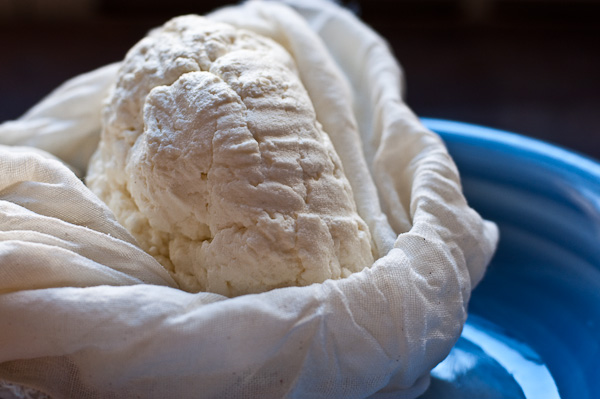
Tie the corners of your butter muslin or cheese cloth into a knot and hang the ricotta over a bowl to drain for 45 minutes to an hour or until it stops dripping. An easy way to set this up is by sliding a chopstick behind the handle of one kitchen cabinet door, through the knot in the butter muslin and then behind handle of the adjacent cabinet door. Then place a bowl on the counter below to catch the draining whey. Just be sure the knot is tight enough to hold the weight. You can also tie the cheese cloth to the faucet in your sink and hang it there with a bowl beneath.

Save the left over whey! You can’t make any more ricotta out of it but it has many uses (see above). I recently used it instead of buttermilk in pancakes to great acclaim.

When the ricotta is finished draining, unwrap and eat! Or use it to make ravioli, eggplant rollatini, lasagna, or cheesecake. If you would like a creamier consistency, you can add a couple of tablespoons of cream and mix thoroughly. It is also makes a stellar breakfast with a little honey drizzled on top. It will keep in a covered container in the refrigerator for 1-2 weeks.

Read Full Post »

Stories make the best condiments. Just think of how many times you’ve tucked into a favorite dish with friends or family and commenced reminiscing about past eating experiences. Maybe it’s the one your uncle Howie tells about the neighborhood bakery that made the best bagels and phenomenal seeded rye and sadly closed down years ago, with nothing opening since that holds a candle to it. Or perhaps you’ve heard that bagels were invented in 1683 when bakers in Vienna celebrated the Polish King Jan Sobieski‘s victory over the Turks by creating a roll in the shape of his stirrup, (German for stirrup is “bügel“). And then there’s the tale that purports to explain why real bagels are boiled before they’re baked. Church leaders in medieval Poland wouldn’t allow Christians to buy any food from Jews, unless it was boiled.

One of the tastiest, and maybe even true, yarns I’ve discovered about bagels recently is the origin of the confederation of Thai bagel rollers found in the best bagel shops in New York these days. If you go into any number of reputable bagelries, where everything, including the shaping of the bagels, is still done by hand, you may be surprised to learn that the toothsome, crusty, chewy delight you’re about to sink your teeth into was created by a person originally from Thailand.

Milton Parker, the owner of the Carnegie Deli, writes in his history of the restaurant, How to Feed Friends and Influence People, that in the 1990s when there was a lot of money sloshing around in Thailand, the government decided it would be a good idea to teach bagel-making to some of its citizens. So it contacted some retired members of the International Bagel Bakers Union Local 338 in New York City and invited them to Thailand. As with many brilliant ideas conceived during boom times, the bagel never really took off in rice-centric Thailand. But, some of those Thai bagel men, and their sons emigrated to the New York and easily found jobs in the better bagel shops.

After recently making bagels at home for the first time, I can tell you that the rolling of the bagel is an important component. Some of mine came out looking very authentic and others, well, let’s just say I need a little practice. But I didn’t care how they looked because they had that snappy crust and chewy interior praised by all bagel lovers. Best of all, I can report that making bagels isn’t any harder than baking bread. It is time consuming but bagels freeze exceedingly well, so make a big batch and fill up your freezer. If you live in a part of the world where it’s difficult to get real bagels (as opposed to rolls with holes), this recipe could be a life saver.

Bagels

Adapted from Peter Reinhart

Modern bagels weigh in at a hefty 7 oz. while historically, they were much smaller (2-3 oz.). This recipe makes about 12 modern size bagels or 18-24 2-3 oz. bagels). I recommend weighing out your pieces of dough so they are all the same size and will cook evenly.

This recipe takes two days to make because the dough is “retarded” overnight in the refrigerator to develop flavor. If you’re in a hurry you can make it without that step, but the bagels won’t be as flavorful.

Please read the recipe all the way through before making your shopping list as there are separate ingredient lists for some steps.

Day 1

Make the Sponge

1 teaspoon instant yeast
4 cups unbleached bread flour or other high gluten flour
2½ cups water, room temperature

In a 4 quart mixing bowl, use a fork to thoroughly stir the yeast into the flour and then add the water and stir with a spoon until it makes a thick sticky batter. Cover with plastic and leave at room temperature until the batter has doubled in size and is quite bubbly (about 2 hours). It may take longer if your kitchen is chilly.

Make the Dough

Malt is a very important ingredient for this recipe as it gives the authentic bagel flavor. Malt syrup is usually sold in health food stores as an alternative sweetener. I was not able to find malt powder, but have heard that some Whole Foods outlets carry it.

½ teaspoon instant yeast
3¾ cups unbleached bread flour or other high gluten flour
2¾ teaspoons salt
2 teaspoons malt powder or 1 tablespoon of malt syrup, honey, or brown sugar

In the bowl of a stand mixer, stir the additional yeast into the sponge and then add 3 cups of the flour, all of the salt and the malt, and mix on low speed with the dough hook until the ingredients are well combined and form a ball. Then, slowly work in the remaining 3/4 cup of flour to form a stiff dough. You can do all of this by hand, with a spoon but it is a very stiff dough so be prepared for a serious workout.

Turn the dough out onto a clean surface and knead for 10-15 minutes. When finished kneading the dough should pass the “window pane” test and should read 77-81 degrees F on a thermometer. If you haven’t used the “window pane test” before, here’s a great video explaining it. If your window pane is still tearing after 10-15 minutes of kneading, add a few drops of water and knead a little more. If your dough is very sticky, add a tiny bit of flour and knead some more. Baking depends very much on the current weather conditions, especially the humidity, so these little adjustments may be needed.

Divide your dough into pieces of the weight you would like your bagels to be. I made 18 3 oz. bagels from this recipe. Form each piece into a roll by stretching down the “sides” of each piece and pinching the dough together in a seam at the “bottom.” Place the rolls, seam down, on a clean surface, cover them with a damp kitchen towel, and let them rest for 20 minutes.

Line 2 sheet pans with baking parchment and spray them lightly with a neutral spray oil (I actually used olive oil because it’s all I had around and it didn’t seem to affect the flavor).

Shape the bagels by using your thumb to poke a hole through the center of your roll and then carefully rotate your thumb, gently stretching the dough around it into an even, doughnut shape. For my 3 oz. bagels I made holes that were about 1 3/4 – 2 inches in diameter, for larger bagels the holes would be larger. When you first stretch the dough it may bounce back. Keep working with it until the hole remains the size you want after you put it down.

Put each shaped bagel on the prepared sheet pans, about 1 1/2 inches away from its neighbors. Mist the bagels lightly with spray oil, wrap the pans in plastic and let them rest at room temperature for about 20 minutes.

Next we check to see if the bagels are ready for their overnight rest in the fridge. Fill a small bowl with room temperature water. Carefully take one bagel and drop it in the bowl. If the bagel floats within 10 seconds, it is ready. If not, then pat it dry, return it to the pan, wrap up the pan and give them another 10 or 15 minutes before testing again.

Once a bagel passes the float test, pat it dry, return it to the pan, wrap up the pan and place the pans in the refrigerator over night or for up to 2 days.

Day 2

Mr. Reinhart’s recipe calls for putting baking soda in the boiling water. Another story I’ve been told about bagels is that the real secret ingredient is New York City water which happens to be a lot softer than much of the water in the US. I’m guessing that Mr. Reinhart has you add baking soda to imitate this softness. I left it out since I am lucky enough to have AOC New York City water coming right out of my tap.

cornmeal
1 tablespoon baking soda (optional)
Bagel toppings: sesame seeds, poppy seeds, kosher salt, etc. (optional)

Preheat your oven to 500 F and put two racks in the center.

Bring a large wide mouthed pot of water to boil on top of your stove. Add the baking soda if using.

Remove the bagels from the refrigerator and drop them gently into the boiling water. Do not crowd the pan, only put in as many as will fit comfortably. Boil the bagels for 2 minutes and flip them over and boil them for another 2 minutes. While the bagels are boiling, sprinkle cornmeal on the same parchment lined pans, this will help prevent the bagels from sticking. When the bagels are boiled, remove them from the water with a slotted spoon or skimmer and place them back in the cornmeal sprinkled pans.

If you are going to top your bagels, do it immediately after they are removed from the water, or the toppings will not stick.

Repeat until all bagels are boiled and topped.

Bake in the center of your oven for 5 minutes, then lower the temperature to 450 F. (Note: I actually forgot to lower the temperature, and it didn’t seem cause any harm). Bake for an additional 10-15 minutes or until the bagels are a dark golden brown. Partway through the baking rotate the pans, swapping racks and also turning them 180 degrees.

Cool on racks for about 15 minutes and serve with the traditional accompaniments of cream cheese (just a schmear), Nova, Gravlax, red onion, capers, whitefish, etc.

Read Full Post »

« Newer Posts