Feeds:
Posts
Comments

Archive for the ‘Food History’ Category

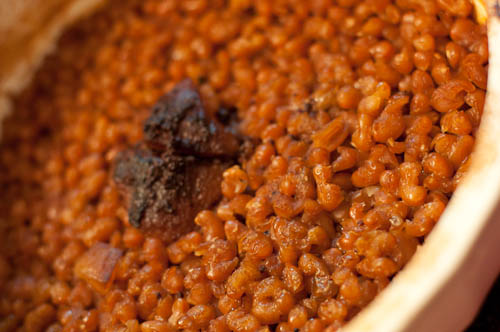
When icy drafts seep through the old windows in our apartment I start thinking about slow cooking. Any dish that requires me to have the oven on for most of the day is a bonus at this time of year, and it also fills the place with tempting aromas. Happily, we have lots of country ham left over from our Yankee Southern Christmas so I thought I would try combining it with it’s classic partner, beans. As mentioned previously, my Mom is from New England, so of course the first thing that popped into my head was Boston Baked Beans.

If you’ve only had “baked beans” from a can, you don’t know what you’re missing. The real thing is totally different, richly infused with the flavor of pork and the earthy tang of Blackstrap molasses. Being a history nerd, I have a facsimile of the Boston Cooking-School Cook Book by Fannie Merritt Farmer which was published in 1896. I figured that would be the best place to go for an authentic recipe. Her recipe uses salt pork but my left over country ham makes a good substitute.

In the process of making this dish I learned a lot about molasses and food science. For a deep complex flavor that is not too sweet, be sure to use real Blackstrap molasses in your Boston Baked Beans. When sugar cane juice is boiled to extract sugar crystals, molasses is left behind. There are three grades of molasses, first molasses, also known as mild or Barbados is produced by the first boil; dark or second molasses comes after the second boil, and finally, Blackstrap molasses from the third boil. Each boiling session creates a more complex and less sweet product. Blackstrap molasses also has the advantage of being very high in some important nutrients such as calcium, magnesium, potassium and iron. It is often sold as a health supplement, so if you can’t find it in your grocery store, try a health food store.

You’ll notice in the recipe that you cook the beans on the stovetop first, and then put them in the oven for a long slow bake. Here’s where I got a lesson in food science from the great Harold McGee. In his book On Food and Cooking: The Science and Lore of the Kitchen, he explains that beans like an alkaline environment for cooking. Once they are exposed to an acid they will not become any more tender, no matter how long they are cooked. Our ancestors may not have had chemistry degrees, but they figured out that if you add molasses to the beans before you put them in the oven, you can leave them there for six hours and they don’t turn to mush. That’s because molasses is an acid and so it helps the beans keep their shape and texture, but they must be fully cooked first.

The origin of Boston Baked Beans is somewhat cloudy. We know that Native Americans in the area cooked beans with maple syrup and bear fat, so it isn’t too much of a stretch to see how that might become molasses and pork fat. This dish was also perfect for the Puritan household where no cooking (or even lighting of the fire) was allowed on Sundays. So Goodwife Smythe would bury the bean pot in the coals of the fire on Saturday night and by the next day the beans were done and could be eaten without breaking any religious tenets. Serve with hearty brown bread for a flavorful, yet healthy antidote to the excesses of the holiday season.

Boston Baked Beans
Adapted from Fannie Merritt Farmer

The traditional bean pot has a lid and its body bulges out slightly in the middle. I used an oven-safe soup tureen. If you don’t have something like that, use a casserole dish and cover it with aluminum foil for most of the baking.

Makes about 4 cups of beans

1/2 pound of dried navy beans (about 2 cups)
1/4 pound of salt pork or country ham
1 1/2 teaspoons salt
1 1/2 teaspoons molasses
4 1/2 teaspoons brown sugar (I like to use Turbinado or Demerara)

Soak the dried beans in water to cover for 4 hours or overnight, then drain and rinse.

Put the beans in a medium saucepan and add enough water to cover them by 2 inches. Slowly heat the water until the beans come to a bare simmer with just a couple of bubbles breaking the surface. If you boil them too hard, their skins will split. Simmer the beans half covered until they are tender, about 30-45 minutes. It is important not to overcook them, so check for doneness every 15 minutes beginning at the 30 minute mark.

Preheat oven to 250F.

When the beans are cooked drain them. Cut a thin slice from the salt pork or ham and put it in the bottom of your bean pot. Pour the drained beans in and then bury the remaining salt pork or ham in the beans with just the rind of the salt pork or fat side of the ham showing.

Mix the salt, molasses and brown sugar with one cup of boiling water and stir until dissolved. Pour this mixture over the beans. If needed add more boiling water to just cover the beans.

Put the lid on the bean pot or cover your casserole with aluminum foil and bake it in the oven for 6-8 hours, uncovering for the last hour to allow the pork to brown. Check the beans occasionally and add water if needed. When done there will be a little liquid left to form a tasty sauce, but most of it will boil away.

Read Full Post »

In his book In Defense of Food: An Eater’s Manifesto, Michael Pollan writes that that stone ground flour is more nutritious than flour made in a mill equipped with metal or porcelain rollers. The thing that really surprised me is that he wasn’t just saying that whole wheat flour is healthier (which it is), but that white flour ground with stones is healthier than white flour ground with rollers.

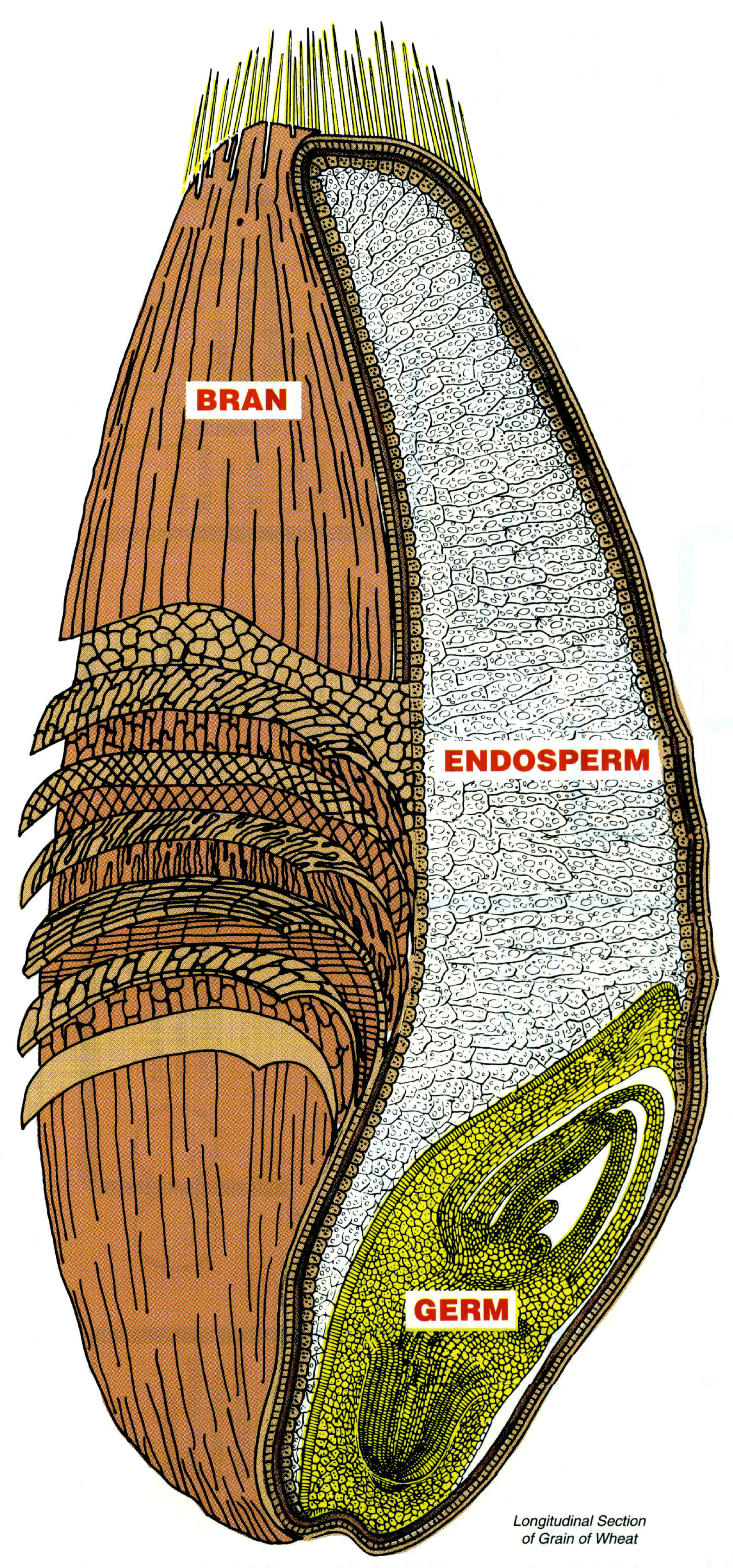
I decided it was time for me to learn a little about the history of flour. After all, it’s a ubiquitous ingredient, seen in cuisines the world over and humans have been making it for thousands of years. For the purposes of this article I’ll be discussing wheat flour, but of course there are many other flours used in different cultures. First, a little wheat nutrition lesson, and then we’ll explore the different ways there are to make flour. A kernel of wheat has three parts, the bran, the endosperm, and the germ. Here’s an illustration:

Most of wheat’s important nutrients are located in the bran and the germ. The bran contains insoluble fiber (important for digestive health), incomplete protein, some trace amounts of B vitamins, and Iron. The germ is the most nutritious part of the wheat kernel containing protein; vitamin E; almost all of the B vitamins, including folic acid; carotenes and other antioxidants; and omega-3 fatty acids. The endosperm (which is the largest part of the wheat kernel) consists of carbohydrates, incomplete protein and trace amounts of vitamins and minerals.

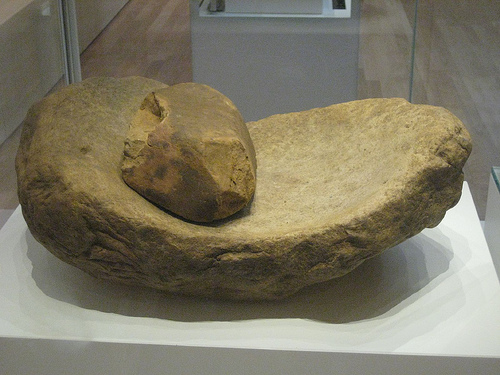
One of the oldest technologies for making flour is the combination of a stone mortar and pestle to initially break the grain, and the saddle quern for grinding it. The saddle quern is an elongated stone with a depression in it where the grain is placed, and then a woman (it was usually a woman) kneels in front of the short end and pushes a smaller stone back and forth over the grain in a rocking motion. It takes a long time to make any useful amount of flour in this manner. In fact, archaeologists examining women’s bones from a Neolithic site in what is now Northern Syria, found many of the women had deformities to their toes, legs, back, and pelvis which can be attributed to spending many hours kneeling in front of a saddle quern. Boy am I glad we don’t have to make flour that way anymore!

A Saddle Quern / Photo by Flickr user unforth

The next development is the rotary quern which consists of two round stones placed on top of each other. The lower stone is slightly convex, and the upper, concave. The top stone has a vertical handle coming from it’s top and a hole in the middle where the grain is fed. The operator (also most likely a woman) uses the handle to turn the top stone, grinding the grain between the stones. The finished flour flows out from between the edges of the stones. Some versions included a spout which would feed the finished flour out into a container. Here’s a great video of someone operating a rotary quern. That still looks like an awful lot of work to get enough flour to make a loaf of bread.

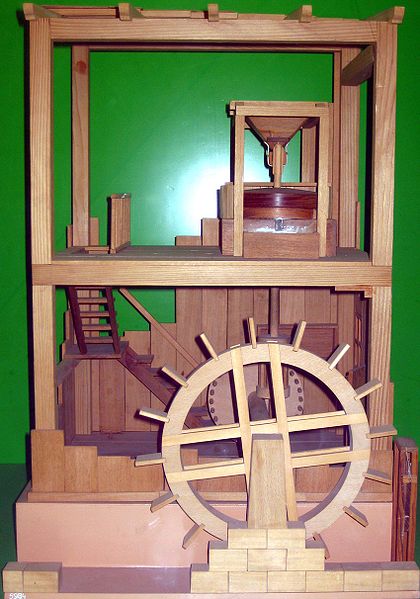
As one might expect, the ancient Greeks and Romans made some important contributions to grain milling technology. The Romans built larger versions of the rotary quern and used animal or slave power to drive them and the ancient Greeks invented the first water mill. A wooden spindle ran from the top stone through the bottom stone. This spindle extended down into a stream and a horizontal water wheel was placed on it. The flow of the water causes the top stone to turn, thus grinding the grain. Eventually the Romans turned the water wheel in the other direction and used gears to transfer the power of the water to the grinding stones. This configuration: a vertical wheel, gears, and two grinding stones working in a rotary manner, remained the predominant method of milling flour until roller mills were introduced in Europe in the 19th Century. There were some changes as to how the stone mills were configured and powered, but essentially the technology was the same for almost 2000 years.

A Model of a Roman Water-powered Grain Mill as Described by Vitruvius (born c. 80–70 BCE, died after c. 15 BCE)

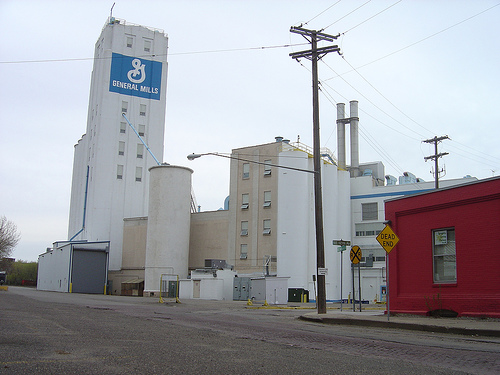
The latest development in flour milling I’ll discuss here is the replacement of grind stones with metal or porcelain rollers which happened around 1870. A mill equipped with rollers uses multiple sets of them turning at different speeds to break the grain and then to grind it. Rollers were faster than grind stones, they produced more flour from a pound of grain and they produced a product with a longer shelf life (more on that later). So it makes sense that the millers of 19th Century Europe and America would jump at the chance to convert their mills to this new technology that would help them make more money and increase their customer base. In fact, in only took about 10 years for most stone mills to be replaced by rollers.

A Modern Flour Mill / Photo by Kate Waxon

So, how do these different milling technologies affect the nutrition of the flour? At some point people discovered they could separate the bran and the crushed pieces of germ from ground wheat fairly easily by sifting it through cloths of an appropriate weave. In Medieval England this was called “boulting” and by using multiple cloths of differing weaves quite fine flour could be made which contained little bran and germ. However this “white” flour still contained the oil from the germ which was released when the germ was crushed during milling. Wheat germ oil, being rich in beta carotene, gave a yellowish gray cast to the flour. The oil also began to oxidize as soon as it came into contact with air, which meant that this “white” flour would only stay fresh for about six months, after which time the wheat germ oil would turn rancid, affecting the taste.

This all changed when rollers were introduced. When grain passes through two rollers moving at different speeds the slower one holds it and the faster one strips it. This meant that not only could the outer bran of the grain be removed as could be done with stone milling, but the germ could be scraped off before grinding. And so was created the first truly white flour, ground solely from the endosperm of the wheat. It was a snowy white and due to the lack of wheat germ and wheat germ oil, it had double the shelf life of the old style “white” flour. Before roller milling was introduced, “white” flour was very expensive and only affordable to the wealthy. The poor used what we would call whole wheat flour today and the truly poor could only afford rye or barley flour. Once roller mills made it more affordable, white flour’s popularity exploded and everyone felt wealthy to have it.

Unfortunately, the lack of nutritional knowledge at the time, meant that millers didn’t understand that in removing the germ from their flour they were taking away a major source of vitamin B, especially from the poor for whom bread was the main source of nourishment. Once roller mills became ubiquitous we see a higher incidence of diseases caused by lack of B vitamins such as pellagra and beriberi.

Once the requisite vitamins were discovered and better understood (during the 1930s) we began enriching some of our flour with Iron, Niacin, Thiamine and Riboflavin. Folic Acid was added to the list in the 1990s. These are of course the nutrients contained in the wheat germ which was removed during the roller milling process. In stone ground “white” flour there is no need for enrichment.

Having learned some of the history of flour milling and how it affects our nutrition, I would now like to bake some bread with stone ground “white” flour and compare it to bread made with good quality all purpose, unbleached, roller milled flour. I’m curious to see if the flavor, color or texture is different. After a cursory bit of looking around, there seems to be plenty of stone ground whole wheat flour available in the US, but hardly any stone ground “white” flour. So far I’ve only found it at Wade’s Mill in Virginia and Central Milling in Ogden, Utah. I might consider mail ordering some from them, but since freshness is so important, I’d really rather get it locally. Please contact me if you have any sources in the New York tri-state area and stay tuned to read the results of my bread baking experiments.

Sources:
Campbell, Judy, et. al. “Nutritional Characteristics of Organic, Freshly Stone-Ground, Sourdough and Conventional Breads” in Ecological Agricultural Projects (McGill University, Quebec, Canada, 1991)
Elton, John “Evolution of the Flour Mill, From Prehistoric Ages to Modern Times” in Souvenir of the First International Miller’s Congress and Annual Convention of the National Association of British and Irish Millers (Paris, 1905)
Hazen, Theodore, R. “How the Roller Mills Changed the Milling Industry” in Pond Lily Mill Restorations
Pollan, Michael. In Defense of Food: An Eater’s Manifesto (New York: The Penguin Press, 2008)

Read Full Post »

“Is Slow Food Really Slow?” is a series here on Comestibles in which we explore the hypothesis that some of the processes many modern home cooks have declared too time consuming are a lot easier than the admen would have us believe.

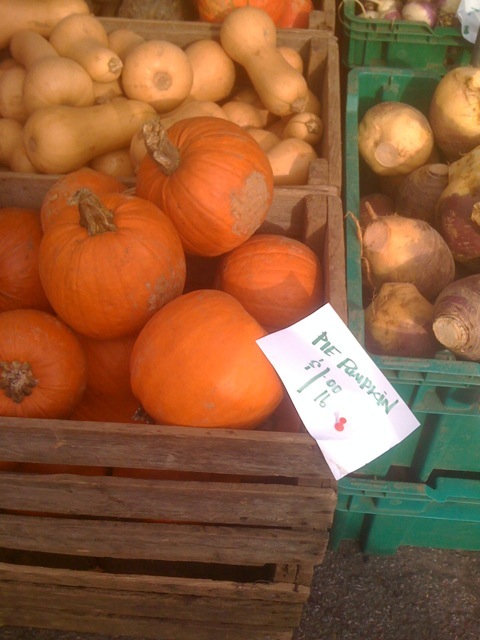
Everybody panic! It’s the great pumpkin shortage of 2009! I, for one, am deeply suspicious that Nestlé/Libby is making it all up to increase sales. I can report that my local grocery stores have plenty of canned pumpkin on the shelves as I write (the Sunday before Thanksgiving) and my mother, who is providing pie — which is of course the best in the universe — for our gathering, has not called to tell me that she will have to make apple instead this year. We had terrible rain during the growing season here in the northeast, and yet, yesterday at the Farmers’ Market, they had lovely pie pumpkins for sale at $1/pound. How are pumpkin supplies in your area?

If you can’t find pumpkin canned or fresh, I would recommend substituting sweet potato or butternut squash, I’ve heard that it’s difficult to tell the difference once the sugar, spices, eggs and cream are added.

When a friend of mine recently gave me a sugar pumpkin from her garden, I got excited because I’ve been wanting to try making pie from fresh pumpkin for years and the best type to use is the sugar pumpkin (sometimes called pie pumpkin). If you try this at home, don’t use a Halloween Jack ‘O Lantern type pumpkin. They are not sweet enough and they’re also quite a bit more fibrous.

I think we can safely say that it will take longer to make a pumpkin pie this way since opening a can only takes about 30 seconds and roasting a pumpkin takes about an hour and a half. However, as with home baked bread, the active time required is a lot shorter than you might think: about 23 minutes. I timed it thus (I have colored the active parts green, for the rest you can be out of the kitchen):

Chop in half and clean out the pumpkin: 15 min.
Bake pumpkin: 90 min.
Cool pumpkin: 15 min.
Scoop flesh out of pumpkin: 5 min.
Puree pumpkin flesh in food processor: 3 min.

So we’ve established that while yes, technically it is slower than opening a can, it’s not as horribly time consuming as you might think. But does the pie taste better? I did not go so far as to make two pies side by side for comparison (I’ll have enough weight to lose after the holidays as it is, okay?), but going on the memory of the many pies I have eaten which were made with canned pumpkin, I can say that I really didn’t detect any particular difference in flavor. It was delicious! However, I found it very satisfying to make a pie the way my great-grandmother would have, and I didn’t have to add another can to the recycling bin.

One thing I did notice is that after roasting, when I pureed the pumpkin it was a very bright orange, not that dull brownish color you find in canned pumpkin. I’m no nutritionist, but I’m guessing there was a lot more beta carotene and other “good for you” compounds in the fresh pumpkin.

So get thee to a Farmers’ Market and buy some sugar pumpkins. The one I used made the perfect amount of puree for pie (you need about 2 cups of puree for a 9 inch pie). I didn’t measure it but it looked to be about an average size based on what I’ve seen for sale. Ask your farmer, I’m sure she can tell you which size to get. Or better yet, buy two and make pumpkin muffins, or pumpkin bread with the extra. The puree also freezes very well, so don’t worry if you have too much.

Fresh Pumpkin Puree

Makes about 2 cups of pumpkin puree

1 medium sized sugar pumpkin (also called a pie pumpkin)

Preheat oven to 350 F.

Cut the pumpkin in half lengthwise and remove the stem. Scoop out the “guts,” saving the seeds if you wish for roasting later. Place the pumpkin halves on a lightly oiled baking sheet, cut side up, and bake until the pumpkin begins to collapse in on itself and the flesh is tender (about 90 minutes).

Allow the pumpkin to stand until it is cool enough to handle easily (about 15 minutes). Then scoop the flesh out of the skin and puree in a food processor until smooth. If your puree seems a little watery (mine wasn’t at all, but pumpkins can vary), line a strainer with cheese cloth and set it over a bowl. Cover the bowl with plastic wrap and leave it to drain overnight in the fridge. The final puree will keep in the refrigerator for 2-3 days and freezes very well.

If you need a pie recipe, try this one from Simply Recipes, it turned out very well and I especially liked the addition of cardamom to the spice mixture.

Read Full Post »

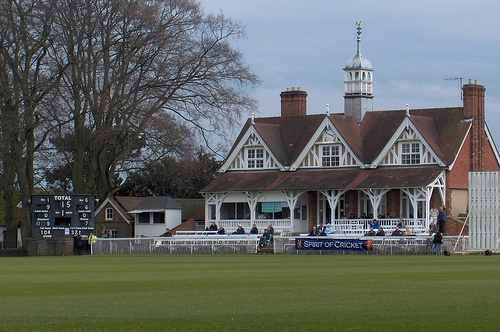
pavilion

Oxford Cricket Pavilion / photo by bishib70

In September I went to food history geek wonderland, namely the 2009 Oxford Symposium on Food and Cookery. It was my first time attending and if you’re thinking about going next year, I highly recommend it.

Each year the Symposium has a theme, alternating between concrete and abstract ideas. For example, this year’s theme was “Food and Language,” an abstract idea, and next year will highlight the more concrete “Cured, Fermented, and Smoked Foods.”

The event is put on by the Oxford Symposium Trust which holds a fund raising picnic each year on the first day of the Symposium. This year to go with the theme, the picnic was based on the Oxbridge Luncheon in Virginia Woof’s book A Room of One’s Own. It was held at the University Parks Cricket Pavilion (see photo above).

The menu was created by Elisabeth Luard, Geraldene Holt, and Derek Muircroft. The gathering was particularly decorated by the presence of Mrs. Woolf herself, in the personage Ms. Ellie Piercy, late of the Globe Theatre. She was received with much enthusiasm by the assembled crowd as she read from A Room of One’s Own and some of her letters; including one to her sister in which she described the stressful day she had to sack her cook. The menu was as follows:

Individual game pies served with spiced pear chutney, salmagundi, and potato salad with Old English Salad Cream.

Glorious Fruits and Friandises

Isis and other cheese by the Oxford Cheese Company

Rice puddings by Mrs. Geraldene Holt

Accompanying wines donated by Penfolds, Peter Lehmann, and Yalumba

It was a lovely late summer day and the historic surroundings only added to the bonhomie. I found my fellow symposiasts — some of whom are very well known in the food world — very welcoming, encouraging this new comer to plunge right into the lively conversation.

Despite the exquisite game pies, I tried to eat lightly because I knew dinner that evening was going to be a real treat. Chef Fergus Henderson, of St. John Restaurant in London, created a dinner based on the diaries of Samuel Pepys, in honor of Harlan Walker, the long-time editor of the Symposium’s proceedings.

Here’s the menu:

Parmesan Cheese Straws and Champagne

Ox Tongue & Beetroot
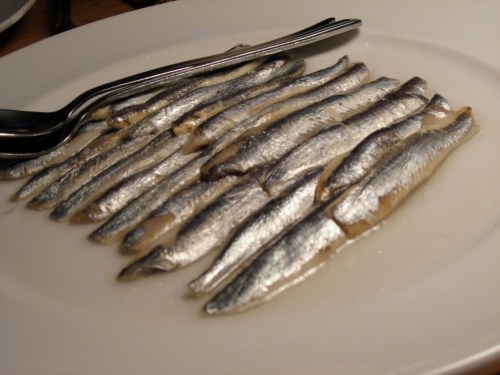
White Pickled Anchovies
Bottarga
Bread and Butter
Served with Solear Manzanilla (Bodegas Barbadillo, SL)

Venison & Trotter Pie
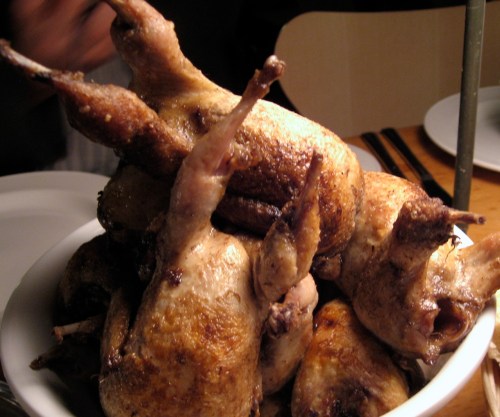
Roast Quail
Boiled Leg of Mutton with Caper Sauce
Fricasée of Rabbit with Peas
Beef Shins
Whole Roast Jerusalem Artichokes
Served with Château Bahans Haut-Brion 1999 & Clarendelle rouge 2004.

St. Paul’s Aflame by Jelly Mongers Bompas & Parr
Served with Málaga No 1 Selección Especial 2006 & Alvear Solera 1927 Px (Bodegas Alvear)

Mr. Pepys’s diary is one of the few contemporary reports we have of the Great Fire of London in 1666. When he saw that the fire was coming close to his house he dug pits in the garden to bury some of his prized possessions, including his wine and a wheel of parmesan cheese. This is what inspired Mr. Henderson to create the Parmesan Cheese Straws we had for an appetizer.

The food was glorious. It was all served family style at the long tables in the dining hall at St. Catherine’s College, Oxford. It really put me in mind of the “groaning boards” of yore described in historical novels. And best of all, I got to eat it surrounded by historians, cookbook writers, journalists, and food enthusiasts of all stripes. Here are a few pictures, to give you the idea:

anchovies

White Pickled Anchovies

quail

A Bowl of Quail

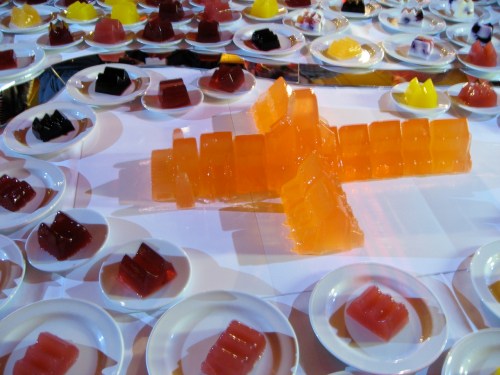
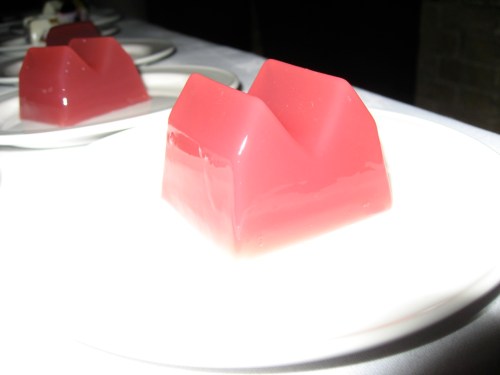
The most exciting part of the evening was the unveiling of the banquet course entitled St. Paul’s Aflame, which was a representation of the Great Fire of London in jelly (that’s Jello to us Americans). It was made by Bompas & Parr, two young men who have recently revived the art of jelly making in the UK.

jelly

St. Paul's Aflame

jellyhouses

Jelly Houses of London

It was presented on a long rectangular table with St. Paul’s Cathedral done in orange jelly; the river Thames represented by curving pieces of mirror traveling down the table; and as far as the eye could see little houses of jelly in different shades of red and orange representing the burning city of London. The jellies were made with natural fruit juices and had just the right amount of sweetness; very different from the neon green Jello of my youth. And of course there was the wobbly factor. After all the wine we had at dinner, we did enjoy poking at our little houses and watching them jiggle.

At this point, the Symposium proper had not even begun! Stay tuned for more reflections on Oxford, 2009 soon.

Read Full Post »

pate3

In pre-World War II Brittany, Autumn was the traditional time to slaughter the pig. The celebration was often called a boudinnerie after the blood pudding that might be made or perhaps a gratonnerie if pork cracklings were on the menu. All the parts of the pig were used to make a large variety of dishes which were then washed down with lakes of cider and eau de vie.

When I first found out I would have the opportunity to cook with some very fresh, local pig’s offal, one of the first cookbooks I opened for inspiration was When French Women Cook by Madeleine Kamman. It is a memoir with recipes that really captures the France of the 1930s-1950s. In the introduction Kamman writes, “most of the recipes in this book have never been written down before,” and then she goes on to describe her relationships with the eight women (conveniently from eight different regions of France) who taught her about cooking at various points in her life.

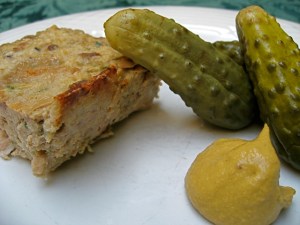
In her description of Breton pig slaughtering traditions Ms. Kamman mentions dishes called cochonnailles or pork delicacies served cold. In honor of the season I decided to use my pork livers and hearts to make Ms. Kamman’s recipe for Grosse Cochonnaille which she translates as Coarse Country Pâté.

Special thanks to Kenny Dahill of MarWin Farm for the very fresh livers and hearts which he provided gratis.

grinding

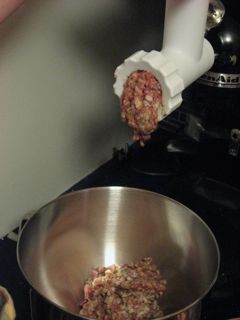
I had never made pâté before and found it relatively easy. The only special equipment you need is a meat grinder. I used the grinder attachment for my KitchenAid mixer and it worked quite well. One technique of pâté making that Kamman does not address in the book is the importance of keeping your equipment and ingredients very very cold. This prevents the fat from separating out of the mixture. Luckily, Ms. Kamman’s book occupies the same shelf in my home as Charcuterie by Michael Ruhlman and Brian Polcyn, which has lots of detail on this subject.

It’s obvious that Ms. Kamman means this dish to be for a celebration as it serves 12! I wound up with a large 9×13 inch baking pan full of porky, fatty goodness. Even though the pâté is made with liver, it’s mild and rich, not too offally at all. I particularly like the spicing which is the traditional quatre épices or four spice mixture that is often used in baked goods like pain d’épices. Here, the hints of cinnamon and clove lend a certain sweetness to the pâté.

This dish is best served with a bottle of Muscadet, crusty French bread, grainy mustard, and lots of pickles.

Grosse Cochonnaille
(Coarse Country Pork Pâté)

Adapted from Madeleine Kamman with technical help from Michael Ruhlman and Brian Polcyn

Serves 12

1 pound pork liver (or a mixture of liver and hearts)
2 pounds Boston butt of pork
1 pound unsalted fatback
4 cloves garlic, peeled and coarsely chopped
2 onions, peeled and chopped in a 1 inch dice
4 shallots, peeled and coarsely chopped
½ cup coarsely chopped parsley
4 slices of white bread, crusts removed
½ cup milk
6 eggs
4-½ teaspoons salt
1 teaspoon quatre épices (see below for recipe)
Freshly ground black pepper
Cayenne pepper

Before beginning, put your meat grinder in the freezer to chill for at least an hour.

Remove the membranes from the liver and cut away the flaps, lobes, gristle and membranes from the hearts (if using), then chop both meats into a 1 inch dice. Cut the Boston butt and the fatback into 1 inch cubes. Toss the chopped meats and fat thoroughly with the garlic, onions, shallots and parsley. Cover this mixture and put it in the refrigerator to keep it cold. You can also use the freezer for this, but if so, don’t allow it to freeze solid.

Tear the bread into 1 inch pieces and soak it in the milk for about 5 minutes. Then break the eggs into the bowl with the bread and milk and add the salt, quatre épices, 6 grinds of pepper from the mill, and a large pinch of cayenne pepper. Use a whisk to beat this mixture together well. Cover the egg and spice mixture and place it in the refrigerator to chill.

Now to grind the meat. It is best to catch the ground meat in a metal bowl as it will retain the cold better. Place the metal bowl inside another bowl filled with ice to prevent the fat from getting too warm during the grinding process.

Remove your grinder from the freezer and set it up. At the last moment bring the meat mixture out of the refrigerator or freezer and grind it as quickly as possible. When finished grinding stir in the cold egg and spice mixture from the refrigerator. Be sure to combine it well so the spices are distributed evenly.

Take a spoonful of the pâté out of the bowl and cover the rest, putting it in the refrigerator so it stays cold. Make a small patty of your spoonful of pâté and cook it in a frying pan. Cool it quickly by putting it in the freezer and taste it cold to check the seasoning of the pâté. Remember that foods served cold need more seasoning than those served hot. Adjust the seasonings and make another test patty if needed. When you are satisfied with the flavors, pour all of the pâté into a 9 x 13 inch baking dish and bake at 350 F for about 45 minutes or until it is nice and brown and the internal temperature reaches 150 F on a thermometer. Remove the pâté from the oven and allow it to cool to room temperature. Then cover and chill for at least 3 hours before serving.

Quatre Épices

2 teaspoons ground cinnamon
4 teaspoons ground allspice
1 teaspoon ground cloves
2 teaspoons grated nutmeg
4 teaspoons ground coriander

Ironically, Madeleine Kamman’s recipe for quatre épices contains five spices. Use the freshest spices possible, grinding them yourself if you can. Mix them together and store in an airtight jar in a cool, dark place.

Read Full Post »

A Cookie Alphabet / photo by Christian Guthier

A Cookie Alphabet / photo by Christian Guthier

In my last post I wrote about the Oxford Symposium on Food and Cookery which I’ll be attending next week.

As well as feeding the mind, the symposium is known for special meals that are created in accordance with each year’s theme. This year on Friday evening, Fergus Henderson, chef of world renowned St. John Restaurant, will cook a meal based on the Diaries of Samuel Pepys. It will be followed by a traditional banqueting course of of jellies (that’s jello to us Americans) representing the Great Fire of London, by Bompas & Parr, a pair of young “jellymongers” who have recently set up shop in London (I’ll try to get some photos, I promise). Saturday night’s dinner will be created by Chef Raymond Blanc of Le Manoir Aux Quat’Saison, a well known French restaurant in nearby Oxfordshire, and will highlight the language of French gastronomy, from the raw to the cooked.

Each year there is also a benefit picnic to raise money for the non-profit organization which runs the symposium. The 2009 picnic will be modeled after the “Oxbridge Luncheon” in Virginia Woolf’s A Room of One’s Own.

If everything works out technologically, I will post brief reports from the symposium here on Comestibles and on Twitter, so as they say, stay tuned. I’m also looking forward to Real Ale, classic pub food and ancient British cheeses while I visit the Cotswolds.

Read Full Post »

a

I like to poke around in the forgotten corners of food history learning what people ate, and how they cooked differently than we do now. Some, like anthropologist Richard Wrangham, say it is cooking that made us human. What better way to learn about people from different places and time periods than by cooking and eating their food? Here I’ll be writing about kitchen experiments with old recipes, preservation and waste prevention techniques of the past, and unfamiliar ingredients. I’ll also include travel pieces exploring the food history of my destinations, and some beginner attempts at food photography.

It’s important that information about traditional foodways not be lost. It can be useful to us today, making our food choices more environmentally friendly, healthier for our bodies and easier on the wallet. Renewed interest in knowing where our food comes from and the resurgence of farmers’ markets and community supported agriculture is making it easier than ever to incorporate these ideas into our daily routines.

I’ve read that in Greece when γιαγιά (that’s grandma in Greek) makes yogurt at home, she doesn’t use a thermometer to tell if it has cooled to the right temperature. Instead she dips her finger in the hot milk and if she can only keep it there for 20 seconds then it’s time to add the starter. These are the kinds of tidbits I hope to unearth and share with my readers.

Thanks for visiting and I hope to see you again soon.

Read Full Post »

« Newer Posts