Feeds:
Posts
Comments

Archive for the ‘Food History’ Category

Photo by Flickr user ageing accozzaglia

Remember restaurants back in the early 1990s when just as you picked up your fork to tuck into that seared Ahi tuna, the waiter would approach wielding a giant pepper grinder? “Would you like some fresh pepper?” he would ask, barging in on your hedonistic revelry.

Those out-sized pepper mills were not invented in 1990, in fact they were a feature of Parisian bistrôts in the 1950s and probably earlier. But in Paris no waiter worth his er … salt would interrupt the sensual communion between diner and plate. If you wanted some pepper you could ask for it. “Excusez-moi, monseiur? Le Rubirosa, s’il vous plait?”

“Rubirosa?” Isn’t “pepper mill” in French “moulin à poivre?”

Well, yes, and no.

Especially on Valentine’s Day, you might earn an extra smile from your French waiter if you ask for the Rubirosa. The sparkling jet-set of French society in the 1950s named the largest pepper mill in the house after Porfirio Rubirosa. A man who some might say was the original Latin Lover and was certainly the last of a dying breed, the international playboy.

In his 56 years he managed to marry 5 women (two of whom were billionaire heiresses), win polo tournaments on 3 continents, drive his Ferrari to victory in Formula 1 races, and take hundreds of lovers including Christina Onasis, Zsa Zsa Gabor, Eartha Kitt, Eva Peron, Gene Tierney, Veronica Lake, Ava Gardner, Rita Hayworth, and Kim Novak, just to name a few. Oh, and did I mention he was a jewel thief?

A native of the Dominican Republic, Rubirosa began his career as an aide-de-camp to Rafael Trujillo. In that position he had unusual access to the dictator’s daughter. Flor de Oro. If Rubirosa had been the proverbial “man in the grey flannel suit,” then angling for the boss’s daughter might have been considered a good move. However, if the “boss” is one of the 20th Century’s most vicious dictators, it’s a good way to get yourself killed. In the first of many examples of his infinite capacity to charm, Rubirosa was allowed to marry Flor in 1932. They were transferred into the foreign service and posted to Europe.

Rubirosa was one of those people who always seemed to be in the right place at the right time. On a diplomatic mission in Germany he sat in Hitler’s box at the 1936 olympics; he represented his country at the coronation of George VI; during World War II he was in Paris, Vichy, Belgium, and the Netherlands. While in Europe he met the French movie star Danielle Darrieux, who became his second wife. Amazingly, Trujillo did not have Rubirosa killed for divorcing his daughter. Legend has it, they fought like cats and dogs and when Trujillo asked about this, Rubirosa defended the right of a Dominican man to beat his wife. In fact, Trujillo called Rubirosa “an excellent diplomat because women adore him and he’s a liar.”

After the war the Generalissimo sent him to Buenos Aires where he stayed during the Peron years and allegedly took Eva Perón as a lover. He was also in Havana during the fall of cuba to Castro. When Trujillo was assassinated in 1961 Rubirosa became a liason between the post-Trujillo government and the Kennedy administration.

At some point, he must have found himself in need of money. The jet-set lifestyle takes a lot to maintain, what with the polo ponies, the bespoke suits, and the Ferrari. So he divorced Danielle Darrieux and married one of the richest women in the world at the time, Doris Duke, heiress to billions (in today’s dollars) through her father’s tobacco company. He divorced her after about a year and a half, coming away with $25,000 a year in alimony (about 200,000 in today’s dollars).

It was after this he began his famous affair with actress Zsa Zsa Gabor. The courtship was like something out of a romance novel. He met her in a hotel elevator, invited her out, she said no, being already engaged. That very evening he moved into the suite next door and filled her room with roses. But their relationship was contentious. She refused to leave her husband George Sanders and marry him. During an argument about it, Rubirosa struck her. The next day she held a press conference at which she arrived wearing an eye patch. The headline in the New York Daily News read: “I said No, So Porfy Poked Me: Zsa Zsa” In some ways, they were perfect for each other, but it was not to be.

Rubirosa and Zsa Zsa Gabor

Next Rubirosa set his sights on Barbara Hutton, who as heiress to both the Woolworth and E.F. Hutton fortunes, was the richest women in the world at the time. They stayed married for 73 days and he got about $3.5 million for it which is about 27 million in today’s money. His last and longest marriage was to a 19-year-old French actress named Odile Rodin. Some say they were a very good match because she was almost as lascivious as he was; constantly out with her numerous lovers at glamorous night clubs, she may have actually succeeded at making Rubirosa jealous.

He died the way he had lived. In the early hours of July 6, 1965, after a night of partying in celebration of his latest polo championship he wrapped his silver Ferrari around a tree in the Bois de Boulogne in Paris.

So how did he do it? He never had much money (of his own), it’s not like he was some European nobleman who had fallen on hard times; there were plenty of those around at the time. He did not climb particularly high in the diplomatic corps, most of his jobs were ahem, ceremonial. He spoke five languages and was always impeccably dressed, but there were others like that. What was Rubi’s secret? Well, remember that pepper grinder in the French bistrôt? It seems that Mr. Rubirosa’s chief attribute was one of endowment.

Cuban composer Eduardo Saborit wrote a song about him called “Que Es Lo Tuyo, Rubirosa” or “What Have You Got, Rubirosa.” Which had the following lyric: “Rubirosa has a thing/and I don’t know what it is/What could it be/ What could it be?/Rubirosa’s thing.” According to Rubirosa’s biographer, Shawn Levy, “when that moment in the song was sung, men on the dance floor would grab their pants around their knees, indicating a physical endowment that you couldn’t talk about out loud then, but which was legendary.” In his unfinished, tell-all, non-fiction novel Answered Prayers, Truman Capote describes Rubirosa’s best asset as “an 11-inch café au lait sinker as thick as a man’s wrist.” Rubi’s ex-wife, Doris Duke, told her godson, “It was six inches in circumference, much like the last foot of a Louisville Slugger baseball bat.”

Famously, Hugh Hefner calls New Year’s Eve “amateur hour” and usually stays at home. I feel the same way about Valentine’s Day. Who needs a special holiday to take your beloved out for a hot night on the town? For Rubi, every day was Valentine’s Day and so should it be for all of us. So wait for an evening when you won’t be overcharged for insipid food, make a reservation at the most glamorous place in town and don’t forget to ask for the Rubirosa.

Read Full Post »

Making ricotta is sort of like getting into the union. You must already have a union job before you can get into the union and in order to make true ricotta you must already have made some cheese. Real ricotta is a dairy product (technically it is not a cheese) made from whey. Whey is a byproduct of cheese making; in particular, ricotta is made from the whey left over after making pecorino, an Italian sheep’s milk cheese.

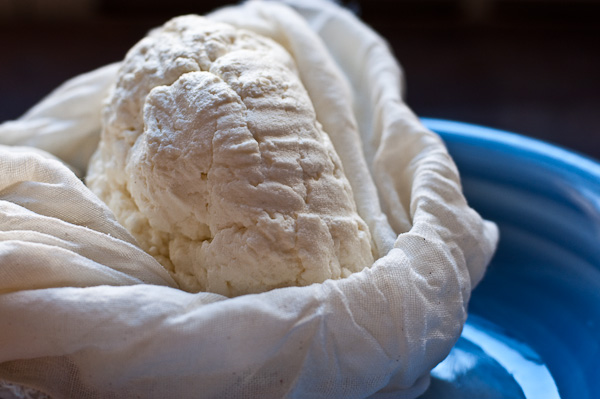
To make true ricotta, the fresh whey is left to stand for 12-24 hours which increases its acidity. It is then heated to a temperature very close to boiling. This causes any remaining protein to coagulate into very fine curds which are skimmed off, drained through some cheese cloth, and allowed to cool.

We don’t really know how long people have been recycling left over whey into a secondary product. Some argue that it is mentioned by Cato the Elder in his De Agri Cultura which was written around 160 BCE. Others claim that the Arabs brought the technique to Europe when they conquered Sicily in the 10th Century.

As usual, our ancestors knew a good thing when they saw it. Whey is packed with important nutrients including protein and riboflavin (vitamin B2). In fact, the Vikings used to drink whey and use it for pickling fish and vegetables. Its acid nature makes it a great pickling agent. Other uses for whey include: replacing the water in any bread recipe, or buttermilk in other baking recipes; feeding it to farm animals, pigs in particular, love it; seasoned with spices it can be used to marinate meat; or pour it on your garden as a fertilizer. Modern dairies often send their whey to be dehydrated and used as a component in the various protein powders favored by body builders.

Even if you don’t have your cheese maker’s union card, you can still make ricotta (or something similar) at home. You just need good whole cow’s milk, salt and citric acid. Citric acid is a crystalline substance that looks a lot like sugar, but tastes like a thousand lemons. If you’ve ever tasted Sour Patch Kids or other super sour candies, you’ll recognize the flavor. Citric acid is sometimes called “sour salt” and can be easily purchased in stores which specialize in Indian ingredients because it is used to make paneer. You can also mail order it from a cheese making supply company. I have seen other recipes for ricotta which use lemon juice or vinegar as the acid component, but I think it’s easier to get the dosage just right with citric acid.

Whole Milk Ricotta
adapted from Ricki Carroll

Makes about ¾ – 1 pound of ricotta

Several pieces of equipment are important for this recipe. You must have a properly calibrated thermometer to measure the temperature of the milk. Test your thermometer by putting it in rapidly boiling water to see if it reads 212F.

You will also need a small fine mesh strainer, no bigger than about 2-3 inches in diameter. This is used to remove the curds from the pot. You can also use a skimmer or perforated ladle, but make sure the holes are not too big.

Finally, you need good quality cheese cloth. If you can get what is called “butter muslin” from a cheese making supply company you will only need one layer. If you use the cheese cloth sold in most supermarkets, use at least 3 layers because it is not woven as tightly.

½ gallon whole milk
½ teaspoon citric acid
¼ cup cool water
½ teaspoon kosher salt

Mix the water and citric acid together in a small bowl and stir until the powder is completely dissolved.

Pour your milk into a large and very clean pot. Add the citric acid solution and the salt to the milk and stir well. Put the pot of milk over a medium-low heat and slowly bring it up to a temperature between 185 and 195 degrees F. Do not allow it to boil. Stir often with a rubber spatula, scraping the bottom to prevent scorching.

You will see the curds begin to form, they are very tiny, perhaps the size of poppy or sesame seeds. After a while the curds will separate from the whey and you will see patches of greenish-yellow whey in the pot. When the curds and whey are completely separated, the whey will not look milky. You can see this by dipping a spoon in and pouring the liquid back into the pot, as it comes off the spoon you’ll be able to see if the whey looks milky or if the liquid is more clear in between the particles of curd.

One the curds and whey have separated, turn off the heat and leave the pot to stand for 10 minutes.

Prepare a strainer or colander by lining it with butter muslin or cheese cloth (see note above) and set it over a large bowl.

Use your small fine mesh strainer or skimmer to gently ladle the curds out of the pot and into the lined strainer. Use slow motions so as not to stir up the curds. When you have ladled as much of the curd out as you can then pour the remaining whey through your strainer or ladle and into another bowl to get the last bit of curd. Don’t discard the whey.

Tie the corners of your butter muslin or cheese cloth into a knot and hang the ricotta over a bowl to drain for 45 minutes to an hour or until it stops dripping. An easy way to set this up is by sliding a chopstick behind the handle of one kitchen cabinet door, through the knot in the butter muslin and then behind handle of the adjacent cabinet door. Then place a bowl on the counter below to catch the draining whey. Just be sure the knot is tight enough to hold the weight. You can also tie the cheese cloth to the faucet in your sink and hang it there with a bowl beneath.

Save the left over whey! You can’t make any more ricotta out of it but it has many uses (see above). I recently used it instead of buttermilk in pancakes to great acclaim.

When the ricotta is finished draining, unwrap and eat! Or use it to make ravioli, eggplant rollatini, lasagna, or cheesecake. If you would like a creamier consistency, you can add a couple of tablespoons of cream and mix thoroughly. It is also makes a stellar breakfast with a little honey drizzled on top. It will keep in a covered container in the refrigerator for 1-2 weeks.

Read Full Post »

SCENE: rural 19th Century England. You stride into a country pub after an invigorating day of grouse hunting, slap your hand on the ancient wooden bar and say, “Landlord, a pint of your finest ale, if you please.”

Oh, pardon me, I was just reading some Sherlock Holmes, which got me daydreaming about tweed, the dark wood interior of the local public house, and of course, beer. Happily, you can live out almost all of this fantasy today. There are many fine country pubs to be found in England that have not changed much since the 19th Century (or earlier). The person behind the bar is still called the landlord or occasionally the landlady. However, until fairly recently, your chances of being served the same kind of beer as you would have been two hundred years ago, were slim to none.

The pint of ale Mr. Holmes quaffed while squeezing the Landlord for facts concerning his latest investigation, would have been pumped up by hand, from a cask or firkin in the pub’s cellar and served at a temperature around 54 degrees F. Its frothy head was the result of gentle, naturally occurring carbonation created by the living yeast that were still in the cask. It would have had a complex aroma, soft mouth feel, and rich, multi-layered flavor. Beer in those days was more like wine, continuously evolving until the moment it was served.

Let’s compare that to the way beer is served in a bar today — a method which began in the mid-1930s and became ubiquitous by the 1950s. The beer is still pumped up from the cellar, however, it’s stored in a keg instead of a cask and the pump is electric is powered by gases like carbon dioxide and nitrogen, which also carbonates the beer. Before being put in the keg at the brewery, the beer is likely filtered to remove the yeast, and/or pasteurized, which kills any remaining yeast and sterilizes the beer extending its shelf life. Removal or killing of the yeast freezes the flavor development of the beer at that moment, it will no longer evolve. Pasteurization (which is basically cooking the beer) changes the flavor drastically, removing some of the more complex flavors and imparting a burnt sugar taste. There is also no natural carbonation in this beer; you need yeast for that. The brewery provides artificial carbonation by pressurizing the keg with carbon dioxide or a mixture of nitrogen and carbon dioxide and further carbonation is also added by the tap system itself. The beer is also served very cold, which is partially accounted for by modern — in particular, American — tastes, but it also hides the fact that these beers don’t really have much flavor compared to their cask cousins from long ago. When something is ice cold, you can’t really taste it.

Do not despair, gentle reader, it is still possible to taste the past. To find out how, I sat down — over some beers, of course — with Alex Hall, “Cask Ale Consultant,” and Mary Izett, certified Beer Judge, and friend. Hall works for U.K Brewing Supplies, an importer of casks and other equipment necessary for bars to serve cask beers and Izett judges homebrew competitions in the tri-state area and writes for Ale Street News.

Cask beer is what Mr. Holmes was drinking back there in the 19th Century and is defined by Hall and Izett as, “unfiltered, unpasteurized beer brewed from only traditional ingredients, matured and naturally carbonated by a secondary fermentation in the container from which it is manually dispensed, i.e., served without the use of nitrogen or extraneous carbon dioxide. It is ideally served at cellar temperature (54F), cool, but not chilled.” Hall describes cask beer as tasting, “funky, more complex, less bubbly, and richer; it has tiny bubbles vs. the big nasty, angry bubbles in keg beer.” Over the last 30 years or so a movement has grown, beginning with the Campaign for Real Ale in England, advocating the return of cask beer. In the last decade, with the help of people like Mr. Hall, it has reached American shores.

When asked why brewers would tamper with a perfectly good product and destroy some of its best attributes in the process, Hall replied that, “keg beer stays fresher longer, and it’s a lot easier to handle than casks.” Once a cask is tapped it must be finished within about 48 hours or it will go off, whereas kegs last 45-60 days. Hall also said that by using kegs brewers prevent losses due to the return of “bad” casks that were actually just mishandled by incompetent barmen. “With casks the barman must be skilled, knowing how to vent them, and allow them to settle. Some cask beers require “fining” [the addition of natural clarifying agents] after they arrive from the brewery. The pub landlord used to be trained in this, but those skills have been lost. With kegs, it’s child’s play, when it’s empty, just plug in another one, anyone can do it.”

Lucky for us New Yorkers, Hall has been evangelizing about cask beer since he arrived here from the UK in 1999. When asked about the best way to try out this delectable beverage he recommended attending a cask ale festival. “It’s the best way to try out many beers. Festivals are very big in the UK,” he said, ” they vary from vast annual events, to small, casual ones in pubs where as few as a dozen — but more often two or three times that number — unusual firkins are thrown up on tables or on temporary [racks].” He organized the first cask ale festival in New York City in 2003 at the Brazen Head in Brooklyn. It was so popular, the bar now holds them three times a year. The next one is this coming weekend. It runs from Friday, February 5 through Sunday, February 7 from 12PM until late each day. Over 30 casks will be available over the course of the festival, with 12 being open at any given time. No cover or minimum.

If you can’t make it to the Brazen Head this weekend, Hall also maintains a website called The Gotham Imbiber where you can download a PDF listing over 50 bars in New York City that have at least one cask beer available at all times. Outside of New York, ask at your favorite craft beer bar about cask beer, the beer geeks will know if there is any around. If you’re lucky enough to travel to the UK, get hold of the Good Beer Guide, to find the best pubs to visit.

Now, if you’ll excuse me, I believe I hear Dr. Watson calling.

Read Full Post »

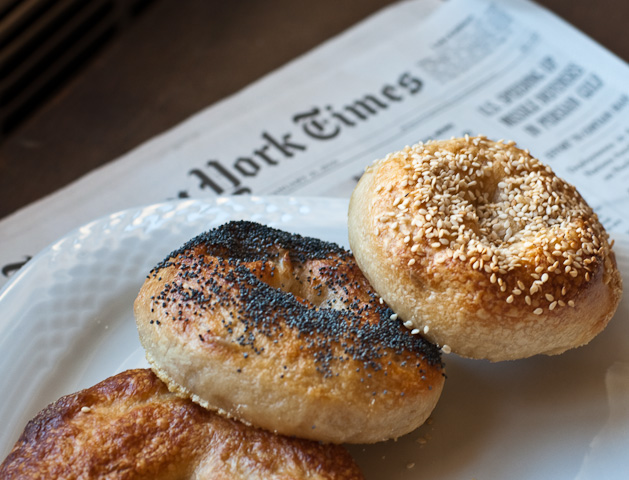
Stories make the best condiments. Just think of how many times you’ve tucked into a favorite dish with friends or family and commenced reminiscing about past eating experiences. Maybe it’s the one your uncle Howie tells about the neighborhood bakery that made the best bagels and phenomenal seeded rye and sadly closed down years ago, with nothing opening since that holds a candle to it. Or perhaps you’ve heard that bagels were invented in 1683 when bakers in Vienna celebrated the Polish King Jan Sobieski‘s victory over the Turks by creating a roll in the shape of his stirrup, (German for stirrup is “bügel“). And then there’s the tale that purports to explain why real bagels are boiled before they’re baked. Church leaders in medieval Poland wouldn’t allow Christians to buy any food from Jews, unless it was boiled.

One of the tastiest, and maybe even true, yarns I’ve discovered about bagels recently is the origin of the confederation of Thai bagel rollers found in the best bagel shops in New York these days. If you go into any number of reputable bagelries, where everything, including the shaping of the bagels, is still done by hand, you may be surprised to learn that the toothsome, crusty, chewy delight you’re about to sink your teeth into was created by a person originally from Thailand.

Milton Parker, the owner of the Carnegie Deli, writes in his history of the restaurant, How to Feed Friends and Influence People, that in the 1990s when there was a lot of money sloshing around in Thailand, the government decided it would be a good idea to teach bagel-making to some of its citizens. So it contacted some retired members of the International Bagel Bakers Union Local 338 in New York City and invited them to Thailand. As with many brilliant ideas conceived during boom times, the bagel never really took off in rice-centric Thailand. But, some of those Thai bagel men, and their sons emigrated to the New York and easily found jobs in the better bagel shops.

After recently making bagels at home for the first time, I can tell you that the rolling of the bagel is an important component. Some of mine came out looking very authentic and others, well, let’s just say I need a little practice. But I didn’t care how they looked because they had that snappy crust and chewy interior praised by all bagel lovers. Best of all, I can report that making bagels isn’t any harder than baking bread. It is time consuming but bagels freeze exceedingly well, so make a big batch and fill up your freezer. If you live in a part of the world where it’s difficult to get real bagels (as opposed to rolls with holes), this recipe could be a life saver.

Bagels

Adapted from Peter Reinhart

Modern bagels weigh in at a hefty 7 oz. while historically, they were much smaller (2-3 oz.). This recipe makes about 12 modern size bagels or 18-24 2-3 oz. bagels). I recommend weighing out your pieces of dough so they are all the same size and will cook evenly.

This recipe takes two days to make because the dough is “retarded” overnight in the refrigerator to develop flavor. If you’re in a hurry you can make it without that step, but the bagels won’t be as flavorful.

Please read the recipe all the way through before making your shopping list as there are separate ingredient lists for some steps.

Day 1

Make the Sponge

1 teaspoon instant yeast
4 cups unbleached bread flour or other high gluten flour
2½ cups water, room temperature

In a 4 quart mixing bowl, use a fork to thoroughly stir the yeast into the flour and then add the water and stir with a spoon until it makes a thick sticky batter. Cover with plastic and leave at room temperature until the batter has doubled in size and is quite bubbly (about 2 hours). It may take longer if your kitchen is chilly.

Make the Dough

Malt is a very important ingredient for this recipe as it gives the authentic bagel flavor. Malt syrup is usually sold in health food stores as an alternative sweetener. I was not able to find malt powder, but have heard that some Whole Foods outlets carry it.

½ teaspoon instant yeast
3¾ cups unbleached bread flour or other high gluten flour
2¾ teaspoons salt
2 teaspoons malt powder or 1 tablespoon of malt syrup, honey, or brown sugar

In the bowl of a stand mixer, stir the additional yeast into the sponge and then add 3 cups of the flour, all of the salt and the malt, and mix on low speed with the dough hook until the ingredients are well combined and form a ball. Then, slowly work in the remaining 3/4 cup of flour to form a stiff dough. You can do all of this by hand, with a spoon but it is a very stiff dough so be prepared for a serious workout.

Turn the dough out onto a clean surface and knead for 10-15 minutes. When finished kneading the dough should pass the “window pane” test and should read 77-81 degrees F on a thermometer. If you haven’t used the “window pane test” before, here’s a great video explaining it. If your window pane is still tearing after 10-15 minutes of kneading, add a few drops of water and knead a little more. If your dough is very sticky, add a tiny bit of flour and knead some more. Baking depends very much on the current weather conditions, especially the humidity, so these little adjustments may be needed.

Divide your dough into pieces of the weight you would like your bagels to be. I made 18 3 oz. bagels from this recipe. Form each piece into a roll by stretching down the “sides” of each piece and pinching the dough together in a seam at the “bottom.” Place the rolls, seam down, on a clean surface, cover them with a damp kitchen towel, and let them rest for 20 minutes.

Line 2 sheet pans with baking parchment and spray them lightly with a neutral spray oil (I actually used olive oil because it’s all I had around and it didn’t seem to affect the flavor).

Shape the bagels by using your thumb to poke a hole through the center of your roll and then carefully rotate your thumb, gently stretching the dough around it into an even, doughnut shape. For my 3 oz. bagels I made holes that were about 1 3/4 – 2 inches in diameter, for larger bagels the holes would be larger. When you first stretch the dough it may bounce back. Keep working with it until the hole remains the size you want after you put it down.

Put each shaped bagel on the prepared sheet pans, about 1 1/2 inches away from its neighbors. Mist the bagels lightly with spray oil, wrap the pans in plastic and let them rest at room temperature for about 20 minutes.

Next we check to see if the bagels are ready for their overnight rest in the fridge. Fill a small bowl with room temperature water. Carefully take one bagel and drop it in the bowl. If the bagel floats within 10 seconds, it is ready. If not, then pat it dry, return it to the pan, wrap up the pan and give them another 10 or 15 minutes before testing again.

Once a bagel passes the float test, pat it dry, return it to the pan, wrap up the pan and place the pans in the refrigerator over night or for up to 2 days.

Day 2

Mr. Reinhart’s recipe calls for putting baking soda in the boiling water. Another story I’ve been told about bagels is that the real secret ingredient is New York City water which happens to be a lot softer than much of the water in the US. I’m guessing that Mr. Reinhart has you add baking soda to imitate this softness. I left it out since I am lucky enough to have AOC New York City water coming right out of my tap.

cornmeal
1 tablespoon baking soda (optional)
Bagel toppings: sesame seeds, poppy seeds, kosher salt, etc. (optional)

Preheat your oven to 500 F and put two racks in the center.

Bring a large wide mouthed pot of water to boil on top of your stove. Add the baking soda if using.

Remove the bagels from the refrigerator and drop them gently into the boiling water. Do not crowd the pan, only put in as many as will fit comfortably. Boil the bagels for 2 minutes and flip them over and boil them for another 2 minutes. While the bagels are boiling, sprinkle cornmeal on the same parchment lined pans, this will help prevent the bagels from sticking. When the bagels are boiled, remove them from the water with a slotted spoon or skimmer and place them back in the cornmeal sprinkled pans.

If you are going to top your bagels, do it immediately after they are removed from the water, or the toppings will not stick.

Repeat until all bagels are boiled and topped.

Bake in the center of your oven for 5 minutes, then lower the temperature to 450 F. (Note: I actually forgot to lower the temperature, and it didn’t seem cause any harm). Bake for an additional 10-15 minutes or until the bagels are a dark golden brown. Partway through the baking rotate the pans, swapping racks and also turning them 180 degrees.

Cool on racks for about 15 minutes and serve with the traditional accompaniments of cream cheese (just a schmear), Nova, Gravlax, red onion, capers, whitefish, etc.

Read Full Post »

Aside from the cute accent, being married to an Australian has other advantages. We get to celebrate extra holidays, which of course involve food. January 26th is Australia Day, commemorating the arrival of the so called First Fleet at Sydney Cove in 1788. It marks the founding of the penal colony of New South Wales and the first European occupation of the continent of Australia.

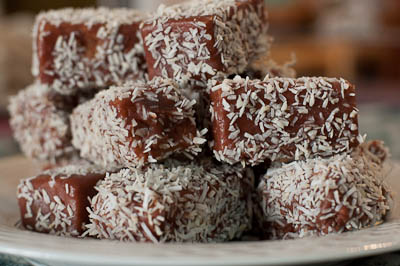
One of the foods that is revered as being uniquely Australian is the lamington, a square of yellow or sponge cake covered in chocolate icing and rolled in dried coconut. Holding a similar place in the hearts of Australians as the brownie does for Americans, lamingtons are often served on Australia Day, but can also be found in bakeries and cafes year round. In particular they are the undisputed star of what we would call the bake sale, but which in Australia is simply known as the lamington drive. Any time money needs to be raised for a good cause, scores of people form assembly lines of cake baking, chocolate dipping and coconut rolling. Or they buy commercially made lamingtons at the store (no worries mate, we won’t tell).

It is thought that lamingtons are named for Charles Cochrane-Baillie, 2nd Baron Lamington, who was Governor of the colony of Queensland from 1896 to 1901. Supposedly, the governor arrived with guests at his summer home Harlaxton House in Toowoomba, which being in a somewhat mountainous area of southern Queensland is much cooler than the tropical north. His chef, Armand Gallad, was taken by surprise and had only day-old sponge cake to serve for tea. Improvising, he dipped the cake in some chocolate icing and rolled it in dried coconut. While nowadays coconuts grow all over Queensland, they were not as ubiquitous in the 19th Century and dried coconut was not a common ingredient in colonial cuisine. Needless to say, the newly invented tea cakes were a big hit with the governor’s guests who immediately asked for the recipe.

Australians are not known for wearing their patriotism on their sleeves, but they do enjoy Australia Day — any excuse for a barbeque; remember, January is summer time down there. Before we get to the lamington recipe, have a look at this ad for Meat and Livestock Australia made by former Australian Rules Football star Sam Kekovich with his rather opinionated take on what should be served on Australia Day:

Lamingtons

Makes 10-12 two-inch squares

You can use any yellow cake or sponge cake for this, but since it is a 19th Century recipe I decided to use a génoise which is an egg-leavened cake that was frequently used to make petits fours and other fancy tea cakes.

Génoise Cake adapted from Julia Child

4 tablespoons unsalted butter, melted
⅔ cup flour, sifted
3 large eggs
½ cup sugar
1½teaspoons vanilla extract
1 pinch salt

Preheat oven to 350F

Prepare an 8 inch round cake pan as follows: put a piece of waxed paper, cut to fit, in the bottom of the pan, then butter it well. Finally, flour the pan, knocking out any excess when finished.

Melt the butter and set it aside to cool.

Beat the eggs, sugar, vanilla and salt with a portable mixer or a stand mixer for about 10 minutes or until they are very thick and pale colored. When you lift the beaters out of the bowl a ribbon of batter should fall from them and lie distinctly on the surface in the bowl before sinking back in. This is what is known as the “ribbon stage” in baking.

Sprinkle about 1/4 of your sifted flour onto the batter and then quickly but gently fold the flour into it until it is almost incorporated. Do your best not to deflate the batter. Add 1/2 of the remaining flour and fold it in. Next, fold in about 1/3 of the cooled melted butter and then continue alternating between flour and butter until everything is incorporated.

Pour the batter into the prepared pan and give it a shake to even it out. Bake for 20-25 minutes or until the top is spongy when pressed and the cake has just started to pull away from the edges of the pan.

Let it cool in the pan for about 10 minutes, then turn it out on a cooling rack. If the cake doesn’t come out of the pan right away leave it upside down on the rack for a few minutes and it should drop out. Peel off the waxed paper if it has stuck to the cake. When the cake has fully cooled (in about 11/2 hours) wrap it tightly in plastic wrap and refrigerate over night.

Chocolate and Coconut Coating

Be sure to check the label on your package of coconut. Much of the stuff sold in supermarket has added sugar, which makes it too sweet.

4 cups (about 1 pound) confectioner’s sugar
⅓ cup cocoa powder
3 tablespoons unsalted butter
½ cup milk
2 cups dried, unsweetened coconut

Remove your génoise cake from the refrigerator and cut it into 2-inch pieces.

In a double boiler, or a heat-proof bowl set over a pot of simmering water (don’t let the water touch the bottom of the bowl), combine the confectioner’s sugar, cocoa powder, butter and milk. Stir together until it becomes a smooth liquid that is easily pourable. Remove the icing from the stove, but leave the water simmering as you will probably need it again during the process.

Pierce each piece of génoise cake with a fork and dunk it in the chocolate icing until it is completely covered. It helps to use a spoon in the other hand to scoop icing over the cake. Hold the piece of cake over the bowl and allow any excess icing to drip off, then place the cake on a plate of dried coconut and quickly roll it to cover all sides. Finally, put the finished lamington on a rack to set.

As you go, you’ll find that the chocolate icing will thicken as it cools, making it difficult to dip the pieces of cake. Bring the bowl or pot back to the stove, set it over the simmering water and stir to regain a pourable consistency. You may have to do this several times during the icing process. If, towards the end, it is still too thick even after reheating, add a little milk to thin it out.

Continue until all of your lamingtons are iced and rolled in coconut. Once they have set they will keep for several days if stored in an air tight container.

Variation: After the lamingtons are set you can split them with a knife and fill the center with strawberry jam.

Read Full Post »

On a recent Sunday evening our house fell under the shadow of a looming work week. A cocktail was needed to lift our spirits. Besides, we had recently purchased some new (to us) cocktail glasses at the Salvation Army (a great source for cheap, nice glasses, by the way) and needed to christen them.

We had rye in the house but no sweet vermouth, so Manhattans were out. We did have dry vermouth however, and in lieu of a Maraschino cherry there was Maraschino liqueur. Since were were improvising, we reached for the Fee Bros. Orange Bitters instead of Angostura, stirred it all up and gave it a try.

Due to liberal use of the bitters it was very orange-y and that, combined with the toasty rye was just the thing for a freezing winter night. As we sat sipping away the blues we wondered what to call it. It wasn’t a Manhattan but it was an almost Manhattan, so of course it should be called a Marble Hill.

For those of you who don’t live in New York City, and those of you who do, but aren’t as obsessed with weird tidbits of history as I am, here’s the story of Marble Hill. It’s a neighborhood that used to be geographically located at the very northern tip of the island of Manhattan. As you may know, the river (well really at that point it’s a tidal estuary) to the west of Manhattan is the Hudson, and the tidal strait (no, it’s not really a river) to the east of the island is called the East River. Connecting the Hudson and East Rivers and going around the top of the island is another tidal strait called the Harlem River. In the late 19th Century it was decided that a ship canal needed to be created to allow larger ships to be able to navigate easily from the Harlem River to the Hudson River. The canal, known as the Harlem River Ship Canal, was dug through one of the narrowest parts of Manhattan, just south of the neighborhood of Marble Hill. After it’s completion in 1895 Marble Hill was an island surrounded on three sides by the original path of the river and to the south by the new ship canal. In 1914 the part of the Harlem River that flowed north of Marble Hill was filled in, connecting the neighborhood to the mainland and making it geographically part of the borough of the Bronx.

Over the years there have been many arguments as to whether Marble Hill should be considered part of Manhattan or the Bronx. A particularly weird episode occurred in 1939 when the Bronx Borough President at the time, James J. Lyons, planted a Bronx County flag in Marble Hill and demanded that the residents declare their allegiance to the Bronx. He even went so far as to call Marble Hill “the Bronx Sudetenland,” a reference to Hitler’s 1938 annexation of Czechoslovakia! The residents of Marble Hill smartly gave him a raspberry (I won’t call it a Bronx cheer) and sent a petition to New York’s Governor to remain a part of Manhattan.

It took a while but in 1984 the New York State Legislature passed a law declaring Marble Hill a part of Manhattan. Unfortunately, residents must put up with a ZIP code beginning in 104 instead of the coveted Manhattan 100 and in 1992 their area code was changed to from 212 to 718 along with the Bronx. However, to avoid confusion they are listed in both the Manhattan and Bronx phone directories.

Next time you want to win a bar bet, ask your opponent to name the northernmost neighborhood in Manhattan.

Marble Hill

It turns out there is already a cocktail named for Marble Hill which contains gin, Dubonnet and orange juice. But I say if there can be multiple Corpse Revivers then there can be multiple Marble Hills too, so here’s ours.

Makes one 4 ounce cocktail

2 1/2 ounces rye
3/4 ounce dry vermouth
3/4 ounce Maraschino liqueur
3 healthy dashes of orange bitters
a twist of orange

Combine liquid ingredients with ice and stir to chill. Strain into proper 4.5 ounce cocktail glasses and garnish with a twist of orange.

Read Full Post »

Cookbook authors only started giving precise measurements and cooking times a little over a century ago, so figuring out older recipes can be a real challenge. One of the earliest cookbooks we have is De re coquinaria or On the Subject of Cooking. Some of the recipes in it are attributed to Marcus Gavius Apicius who lived in the 1st Century CE and was famed as a gourmet. The book is sometimes also simply referred to as Apicius.

Not being a Latin scholar, I am indebted to the archaeologist-cook Ilaria Gozzini Giacosa who has given us A Taste of Ancient Rome (translated by Anna Herklotz). In this detailed and entertaining book, Ms. Giacosa, gives us everything we need in order to attempt some of Apicius’s ancient recipes in the modern kitchen. Here is Ms. Herklotz’s English translation Apicius’s original recipe for Duck with Turnips:

“Crane or duck with turnips: Wash, truss and boil in a pan with water, salt, and dill until half cooked. Cook the turnips so that they lose their bitterness. Remove the duck from the pan, wash again, and place in a pot with oil and garum and a bouquet of leeks and coriander. Over this put a turnip that has been well washed and cut into very small pieces, and cook. When it has cooked somewhat, add defructum for color. Prepare this sauce: pepper, cumin, coriander, and silphium root, moistened with vinegar and cooking broth. Pour over the duck and boil. When it boils, thicken with starch and add over the [remaining] turnips, Sprinkle with pepper and serve.”

Aren’t you glad they don’t write recipes that way anymore? Ms. Giacosa redacts the recipe, adjusting it to modern expectations by giving some measurements for the ingredients and leaving out the boiling of the duck, instead going straight to roasting it in a pot. The resulting recipe is actually very similar to a classic French dish called Caneton Poêlé aux Navet or Casserole-roasted Duckling with Turnips. I decided to put the two together and make a sort of Caneton Poêlé aux Navet á l’Apicius by using the French method with the ancient Roman flavors.

You may have noticed a few unfamiliar ingredients in the original recipe, namely: garum, defrutum, and silphium. Garum is perhaps the most ubiquitous ingredient in ancient Roman cooking. It is a fermented fish sauce they used to put on just about everything. The best garum came from what is now Spain and Portugal, regions still known for their fish cookery, and Roman nobles would pay a pretty denarius for it. Someday I would like to attempt making my own garum, but considering it requires layering fish innards with salt in a clay pot and leaving it out in the sun for three months, I think it will have to wait. There was a reason the garum factory was always located on the outskirts of town. Luckily, fish sauce is still beloved by Thai and Vietnamese chefs, among others, so for this recipe I used the Thai fish sauce called nuoc mam which is widely available at stores selling asian ingredients or even in the asian section of your supermarket.

Defrutum is a sweet syrup made by boiling grape must (what is left after the grapes have been crushed to make wine) and reducing it to about half its original volume. This ancient ingredient has survived in two different products still made in Italy, saba, and vincotto. They are essentially the same as defrutum but have been aged in oak barrels (which the Romans did not use). Sometimes vincotto is mixed with vinegar or fruit flavors so read the label carefully when shopping to make sure you get the plain version. I found some vincotto in a gourmet shop, I have also seen both vincotto and saba for sale online.

Our final mystery ingredient is truly a mystery. Silphium (also called laser by the Romans) was coveted by the wealthy as an exotic ingredient, and was so expensive that only the tiniest amounts were used. It is a resin from a plant that is now extinct. It is thought to be from the genus Ferula. It grew only in a small area near the ancient Greek settlement of Cyrene in what is now eastern Libya. The reason for its extinction is unknown, some speculate that it was farmed intensely until the soil was depleted, others think animals were grazed on it to improve the flavor of their meat, leading to overgrazing and extinction. Supposedly the last stalk of silphium was given to the emperor Nero (37 CE – 68 CE) as a gift.

Once there was no more silphium to be had, the Romans took to using another plant instead which they called laser parthicum. We think that laser parthicum is asafoetida, a plant in the same genus as silphium. Asafoetida is still used today in cooking in the Middle East and Asia. In particular it is used by Jainists as a replacement for garlic and onions which their religion forbids them to eat. Asafoetida is available at stores which sell Indian spices. Beware, it is extremely pungent, keep it in a well-sealed container if you don’t want your entire kitchen smelling like, well, armpit. Don’t be alarmed, when you cook with it, the smell changes into something like very savory caramelized onions. It lends a tangy almost citrusy flavor to the finished dish, which combined with the earthy cumin and coriander makes it taste very middle eastern. Nowadays we think of Rome as a great western city, but before tomatoes, pasta and many other foods became part of its cuisine, Roman food was very much influenced by the lands it conquered in the mysterious east.

Duck with Turnips á l’Apicius

Adapted from Apicius and Ilaria Gozzini Giacosa with a little help from Juila Child

Serves 4

1 large duck (about 5 pounds)
3 tablespoons olive oil
1 teaspoon Thai fish sauce (nuoc mam)
1 small leek
1 bunch fresh cilantro
2 pounds fresh turnips
2 tablespoons vincotto or saba

Sauce:
1 ½ teaspoons ground cumin
1 ½ teaspoons ground coriander
½ teaspoon asafoetida
1 tablespoon balsamic vinegar
2 tablespoons olive oil
3 tablespoons flour
1 – 1½ cups duck or chicken stock

Preheat oven to 325 F.

Wash the duck and pat it thoroughly dry inside and out.

Truss the duck by tucking the ends of the wings underneath the bird and tying the legs together with kitchen twine. If the wing-tips have been cut off, tie another piece of twine around the middle of the duck to secure the wings to its sides. Use a sharp knife or skewer to prick holes in the duck skin around the thighs, back and lower part of the breast. This helps render the fat out while cooking.

Heat 2 tablespoons of olive oil in a dutch oven. Over medium-low heat, brown the duck carefully in the olive oil turning it so all sides are nicely brown (about 20 minutes).

Remove the duck from the dutch oven and pour off the oil. Put 1 teaspoon of Thai fish sauce in the dutch oven along with 1 tablespoon of olive oil. Return the duck to the pot and add a bouquet garni consisting of the leek trimmed of its roots and dark green leaves and the bunch of cilantro tied together with kitchen twine. Peel and cut 1 turnip into a small 1/2 inch dice and sprinkle it over the duck. Cover pot and put it in the center of your oven for 15 minutes.

While the duck is cooking, prepare the rest of the turnips. Peel the turnips and cut them in a larger 1 inch dice. Cook them in salted boiling water for about 5 minutes. Drain the turnips and set them aside.

When your duck has cooked for 15 minutes, add the partially cooked turnips to the dutch oven, arranging them around the duck. Using a pastry brush, paint the duck with 2 tablespoons of vincotto or saba. Return the duck to the oven for about another 35 minutes or until a thermometer inserted into the thickest part of the thigh reads 165 F and the juices run clear. Baste the turnips occasionally with the pan juices during this last phase of cooking.

When the duck is cooked, remove the it and turnips from the pot and put them on a hot serving platter. Cover with tented aluminum foil and allow the duck to rest (and finish cooking) while you prepare the sauce.

Pour the juices from the dutch oven through a fine mesh strainer and into a liquid measuring cup. Let it stand for a minute to allow the fat to rise to the surface. Use a spoon to remove as much fat as you can, or use a fat separator if you have one. Once the juices are defatted, see how much you have. Add duck or chicken stock until you have a total of 2 cups. Pour your 2 cups of stock and cooking juices into a small saucepan and bring it to a simmer over medium heat.

In a medium saucepan heat 2 tablespoons of olive oil over low heat. When the oil is hot, use a whisk to blend in 3 tablespoons of flour. Continue whisking until the flour begins to turn a light brown. Remove the pot from the heat and immediately pour the hot stock and cooking juices into the flour and oil mixture and continue whisking until completely blended and the sauce begins to thicken. Put the pot back over a medium-low heat and add the cumin, coriander, asafoetida and balsamic vinegar, whisking to combine. Bring the sauce to a simmer and cook for a few minutes, partially covered to combine the flavors. Season to taste with salt freshly ground black pepper and serve on the side with the duck and turnips.

Read Full Post »

Hummus is immensely popular in Israel, where it is widely acknowledged to be of Arab origin. Ask anyone where to find the best hummus in Jerusalem and they’ll send you to the Arab Quarter. You might think this would be a problem for Arab-Israeli relations, but actually, as noted in a recent article in The Economist, the only thing Israeli and Arab negotiators could agree on in Shepherdstown, West Virginia ten years ago, was the fact that the American hummus was ghastly. Who knows, maybe the Israelis and Arabs will agree to share Jerusalem, so everyone can continue to get their daily chickpea fix. It brings new meaning to the idea of whirled peas.

Having everyone sit down to a meal may sound like a simplistic way to solve such complex international issues, but Senator George J. Mitchell, President Obama’s Special Envoy to the Middle East, had quite a bit of success with just that tactic in the Northern Ireland peace negotiations. He hosted a dinner during which the negotiators were forbidden the topic of politics and were encouraged to discuss more personal things such as family and hobbies. A few days after that dinner, the first glimmers of mutual understanding were seen among the parties, leading eventually to the signing of the Good Friday Agreement. If he tries it again, I would advise Senator Mitchell to get the best hummus money can buy. Or better yet, have the negotiators contribute their own family recipes.

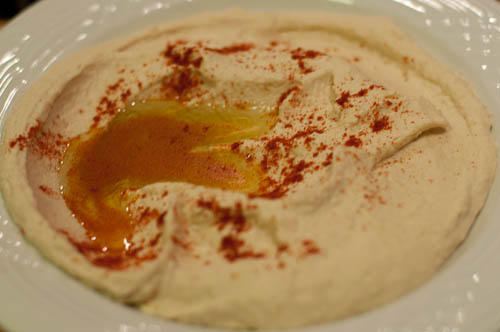
As with many traditional dishes, we don’t know the origin of hummus. The word comes to us through Turkish, from the Arabic. As is often the case with food words, it simply means what it is, “chickpeas.” The full Arabic name of the dish is hummus-bi-tahina (chickpeas with tahina, or sesame paste). If you’ve only ever bought it in the grocery store or made it with canned chickpeas, you may think of hummus as heavy and pasty. The real dish is nothing like that, when freshly made, with good ingredients, it is light and fluffy, with bright lemon and earthy garlic bringing out the flavor of the staid chickpea.

Hummus
adapted from Mediterranean Street Food by Anissa Helou

Makes about 2 cups

1/2 cup dried chickpeas, soaked in water for 4 hours or overnight
1/3 cup tahini
2 cloves garlic, peeled
salt
4 tablespoons lemon juice or to taste
paprika
fruity olive oil
olives (optional)

Drain and rinse the chickpeas. Put them in a saucepan and enough water to cover them by about an inch. Bring to a boil and then lower the heat to a simmer. Simmer the chickpeas partially covered for about 45 minutes or until very tender.

Drain the chickpeas and reserve the cooking water. Place the chickpeas in a food processor with the tahini and garlic. Process into a smooth puree. Check the consistency, it should be creamy, if it’s too thick add a couple of tablespoons of the chickpea cooking water to thin it out.

Add salt to taste, processing to blend it in.

Add the lemon juice a little at a time, processing to blend, until it tastes the way you like. At this point you may need to add more salt to balance the lemon juice. I find that I go back and forth between the two until it tastes just right.

Serve in a shallow bowl or on a small platter. Make a slight depression in the center of the hummus, sprinkle the paprika on top and pour some nice fruity olive oil into the depression. Garnish with olives if you like.

Serve with pita bread and vegetables for dipping.

Read Full Post »

Photo by Flickr user Shabbir Siraj

I remember the first time I had chai in an Indian restaurant. I was transported to an imaginary spice market, sitting in the shade, watching the crowds flow by, while a merchant tried to convince me that his turmeric was worth the extra money. Good chai is exotic, creamy, sweet, spicy and invigorating, all at the same time.

A certain overpriced coffee purveyor, which shall remain nameless (with a green and white logo) serves a concoction they blithely call “chai.” It comes from a liquid concentrate which is then mixed with steamed milk. When I’ve tried it, all I could taste was the sweetener (I’ll give them credit, it is sugar and not corn syrup) and very little tea or spices. In a quest to duplicate that first chai experience, I decided to make some for myself. It turns out to be incredibly simple and I will most likely never buy chai from a coffee bar again.

First, a little history. The word “chai” simply means tea in Hindi, Punjabi, and actually, many other languages around the world. Tea has grown in India since prehistoric times, in particular in the region of Assam. But until much more recently that you might think, tea in India was seen as an herbal medicine, not an everyday beverage.

India was part of the British Empire from 1858-1947. At the time, the British were prodigious drinkers of tea, consuming about one pound of tea leaves per person, per year. The majority (90%) of that tea was coming from China, expensively imported by the East India Company. As soon as they came into power in India, the British began to cultivate tea plantations there, in order to have more direct control over the source of their favorite beverage. They also grew tea in Ceylon (now called Sri Lanka). By 1900 50% of the tea drunk in Britain came from India and 33% from Ceylon.

What does this have to do with chai in India? Once tea became big business in India the usual trade organizations grew up around it. Specifically of interest in this story is the Indian Tea Association, founded in 1881. Beginning in the early 20th Century, the Indian Tea Association began a campaign promoting tea to Indians. The organization encouraged employers to give their workers tea breaks, and it supported chai wallahs (tea sellers) at strategic locations such as railway stations. Initially, the tea sold by the chai wallahs was the same as you would find in Britain, black tea with a little milk and sugar. The Indian Tea Association did not approve of any deviation from this model. Over time, independent chai wallahs started popping up and they put a local spin on this new beverage by adding Indian spices and boiling all the ingredients together, including the tea. Besides inventing a new drink, this was a way for the chai wallahs to save money and buy fewer tea leaves. When tea leaves are boiled, the end product is strong and bitter, but this is tempered by the addition of spices and boiling in a mixture of milk and water. To distinguish this new, exciting drink from the British version, Indians began to call it masala chai which means “spiced tea.”

Before we look at the recipe, take a moment to watch this lovely short film by Nick Higgins of a holy man brewing masala chai over a twig fire in New Delhi.

Masala Chai

Makes 2 small cups

There are just about as many recipes for masala chai as there are people in India, so feel free to experiment with different spices, amounts of milk and sugar, and cooking time until you get something you like. Other popular spices include star anise, fennel, mint leaves, liquorice, and saffron. One tip: don’t skimp on the sugar, it brings out the flavors and counteracts the bitterness of the tea.

1/8 teaspoon ground ginger
2 whole cloves
1 cinnamon stick
2 whole black peppercorns
2 cardamon pods
1 tablespoon of black tea (I like to use Assam)
1 1/4 cups water
1/3 cup milk
2 tablespoons brown sugar (turbinado or demerara are nice)

Lightly crush all of the spices. Put the tea, spices and water in a pot and bring to a rolling boil. Turn the heat down and let it simmer for about 3 minutes. Add the milk and sugar and stir.

Bring the mixture to a boil again. As soon as the milk begins to foam up the sides of the pot, remove it from the heat and strain through a fine mesh strainer into a pot from which you will serve it.

Read Full Post »

During an uncharacteristic flurry of New Year’s cleaning, I found myself weeding the bookshelves; always a difficult prospect, but especially when it comes to the cookbook section. Well, it turns out my hoarding instincts sometimes pay off. Growing up in Australia, my husband was given a British cookbook called Poor Cook: Fabulous Food for Next to Nothing by Susan Campbell and Caroline Conran. I love quirky old cookbooks and so would never get rid of it. On a lark, I looked to see if it was still in print. It isn’t. However, used copies are going for over $100 on Amazon!

Originally published in 1971, Poor Cook is remarkably prescient when it comes to discussing the intrusion of convenience foods on the home kitchen. In the introduction, authors Campbell and Conran write that, “pre-packed foods have been expensively prepared by other people, however cheaply they may have been bought in their original state, and are lavishly packaged and advertised. And if the people who enjoy feeding their families continue to carry their shopping baskets steadfastly past the supermarket door, in search of the odder cheap ingredients, then the shops will go on selling them, but if nobody asks for things like belly of pork and breast of lamb they will soon disappear for ever.”

Sound familiar?

They also heap praise upon their local butchers, thanking them in the acknowledgements and reminding readers that they should, “always be extra nice and good-tempered in the butcher’s shop; it really is worth being good friends with the man who sells you your meat. He will advise you which piece of the animal would be most suitable, if you tell him what you want the meat for. He is also more likely to be prepared to do tedious work in the way of boning, mincing and cutting a joint just so, if he is your friend and sees that you care, and if you make a point of going into the shop when it is not particularly busy.” And here I thought rock star butchers were a phenomenon of the 21st Century.

For all it’s similarities to the modern day, the book also shows the difference between the cookbook publishing industry then and now. Along with wholesome, simple recipes for dishes like Chicken Broth with Butter Dumplings, and Brisket in Beer, the book has an entire chapter titled “Pâtés, Terrines, Pies and Brawns” which includes some challenging dishes such as Galantine of Breast of Veal, and Brawn (aka headcheese), which modern readers are only used to seeing in specialty books like Michael Ruhlman’s Charcuterie. Campbell and Conran admit that things like terrines and raised pork pie “are all quite considerable tests of cooking ability,” but they warmly encourage the reader, saying, “don’t be surprised if the first one you make looks a bit strange; it gets better with practice, and it is a lovely thing to be able to produce at a picnic.” I much prefer this to today’s 30-minute wonder books.

As in many parts of the world in the late 60s and early 70s, food prices in Britain were climbing. Campbell and Conran wrote this book to help people get back to traditional cooking with cheap, simple ingredients. With foreclosures and unemployment at record highs, that’s something we could use a little of right here in 2010. Throughout the year I will cook some recipes from Poor Cook to see if they are as affordable now as they were back then; and more importantly are they tasty? Meanwhile, when you get around to your Spring, or Summer or whenever cleaning be sure to check those shelves for hidden, out-of-print gems.

I couldn’t resist starting with the terribly English sounding Toad in the Hole. We have no solid evidence for the origin of the name. The earliest usage is 18th Century and there is an English pub game with the same name, but that’s about all we know. The dish is essentially sausages in a Yorkshire Pudding-type batter; not exactly diet food, but great eating in this cold weather we’ve been having. The batter poofs up around the sausages into a light eggy cloud with crispy edges. The version in Poor Cook also includes bacon which I haven’t seen before, but who am I to argue? As long as you don’t buy fancy gourmet sausages and bacon, you can serve four people for about $10. Add a salad and a side of Boston Baked Beans, and you’ve got a cheap and cheerful winter dinner.

Toad in the Hole

adapted from Poor Cook by Susan Campbell and Caroline Conran

Serves 4

4 large sausages
4 slices bacon
4 oz. all purpose flour (about a cup)
1/2 teaspoon salt
2 large eggs
1 generous cup milk
2-3 tablespoons lard or canola oil

For the batter, use a fork to blend the flour and salt in a mixing bowl. Make a well in the center and break the eggs into it. Gradually add the milk while mixing with a portable mixer or a wooden spoon until all of the flour is absorbed into the batter, there will still be some milk left. Add the rest of the milk and then beat for 2-3 minutes with a portable mixer or 5-10 minutes with a spoon. Cover the batter and let stand in a cool place for 1 hour.

Preheat oven to 475F.

In a skillet, fry the bacon for 2-3 minutes and remove to a plate. Add the sausages to the skillet and cook until they are nicely done. Put the lard or canola oil into an 8 x 8 inch baking dish and place it in the oven for 5 minutes to get it nice and hot. When the lard is melted and hot or the oil is hot, put the bacon in the bottom of the baking dish and the sausages on top, lying parallel to each other and return the dish to the oven for about 5 minutes. Have your batter ready, take the baking dish out of the oven, pour the batter over the meats and return the dish to the oven. Bake for 5 minutes at 475F and then lower the temperature to 425F and bake for 35-40 minutes. The batter will puff up around the sausages and turn a rich golden brown.

Read Full Post »

« Newer Posts - Older Posts »