Feeds:
Posts
Comments

Archive for September, 2010

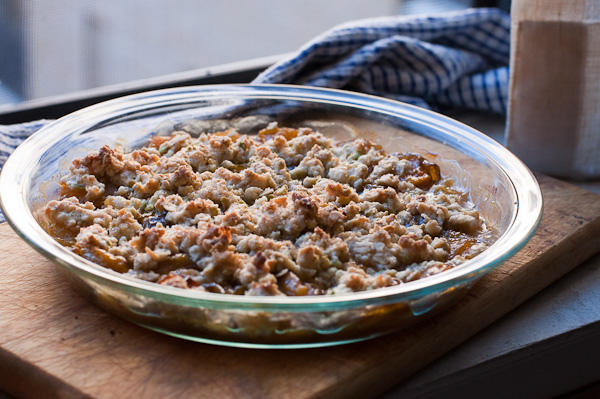
Greengage and Pistachio Crumble Cooling on the Windowsill

Somehow foreign names for ingredients always sound exotic. Wouldn’t you rather make aubergine Parmesan, than just plain old eggplant? Or creep away after leaving baskets of excess courgettes on your neighbor’s doorstep in the middle of the night instead of secretly gifting them with zucchini?

One mysterious ingredient I always wondered about in British cookbooks was the greengage. Despite sounding like a sort of lab equipment for measuring chlorophyll, it turns out to be a particular varietal of plum very popular in the UK and not at all well known on this side of the pond. After reading of their preternatural sweetness which is coveted in Britain for desserts and jams, I really wanted to try some. Alas, through the fruit was grown in America when we were but colonies of mother England, it is rarely found here now. Greengages can be difficult to grow and even harder to get to market as they do not ship well, so American farmers switched to less persnickety types of plum.

The greengage (Prunus domestica italica) is originally a French varietal where it is called Reine Claude after Queen Claude (d. 1524), wife of King Francis I of France. Around 1725 Sir William Gage, 7th Baronet of the name, introduced these succulent sweeties into England. An unsubstantiated story tells us that during shipping the labels came off the plum trees. Since they were green and owned by Gage, they became known as greengages.

Greengages?

You can imagine my excitement when I ran across greengages for sale at the Grand Army Plaza Farmers’ Market in Brooklyn last Saturday. When I got them home and started to do a little research into where they came from and how they got their name, I found that in the US other types of green plums are often labeled “greengage” even if they are not. I tasted them and honestly, they didn’t strike me as any sweeter than other plums I’ve had, so I’m wondering, are they real greengages? Or perhaps they were picked a little too soon? I read that they don’t really ripen well after picking. British readers, please have a look at the photo above and weigh in about their authenticity in the comments. For reference they are about the size of a golf ball and the flesh inside is golden.

Whether or not they are actual greengages I decided to make a dessert with them anyway. I chose a Greengage and Pistachio Crumble from a British book called Healthy Fruit Desserts by Christine McFadden which is full of not-too-sweet dishes containing unusual ingredient combinations. I loved the idea of putting green pistachios together with their plum cousins. The crumble was pleasantly tart and I really enjoyed the crunchy topping which the oats made quite substantial. This is one of those desserts that also makes a great breakfast, containing far less sugar than most of what you find in the cereal aisle.

Greengage and Pistachio Crumble
adapted from Christine McFadden

Serves 3-4

¾ lb. ripe greengages
2 oz. sugar (about 4 tablespoons)
2 oz. unsalted butter (about ½ tablespoon)
1 oz. shelled pistachios
2 oz. all purpose flour
2 oz. rolled oats
Demerara sugar for garnish

Preheat your oven to 375F.

Pour boiling water over the pistachios and let them stand for about 5 minutes. Drain the pistachios, squeeze them out of their papery skins and chop the nuts finely.

Cut the greengages in half and remove the pits. Place them in a saucepan with ¼ ounce of the butter and 4 teaspoons of the sugar. Cook them over medium-low heat, stirring occasionally and very gently, until the butter and sugar melt and the greengages start producing juice. Pour the cooked greengages into a 9 inch pie plate.

Stir the flour and rolled oats together. Cut the remaining butter into small pieces and use your fingers to rub it into the flour and oat mixture until the result looks like breadcrumbs or peas. Add the chopped pistachios and the remaining sugar and stir. Next, add water 1 teaspoon at a time until the dough comes together into a crumbly mixture.

Scatter the dough over the greengages in clumps and sprinkle with Demerara sugar.

Bake the crumble in the center of the oven for 25-35 minutes or until the top is golden brown.
Read Full Post »

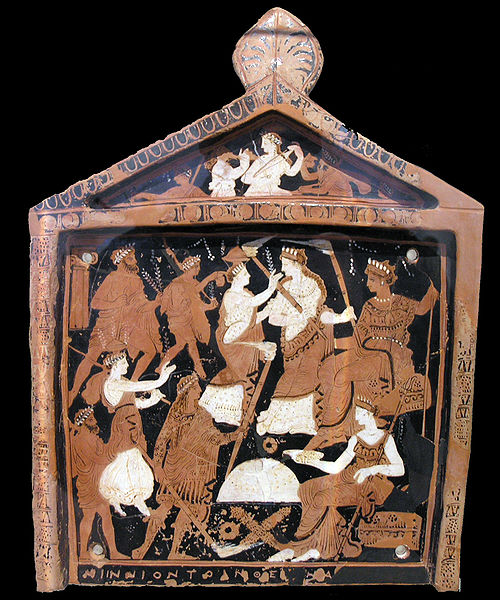
The Ninnion Tablet (circa 370, BCE) depicting the Eleusinian Mysteries / photo by Wikipedia user Marsyas

I first ran across barley water when reading a novel set in early 19th Century Britain, where it was prescribed as a drink for the ill and infirm. It turns out to be a lot older than that. For almost 2000 years barley water was the sacred drink of the Eleusinian Mysteries, an ancient Greek religious harvest celebration.

The people of Eleusis worshiped Demeter, a grain goddess. The myth connected with the Mysteries is as follows: One day Demeter’s daughter, Persephone, was gathering wild flowers in a meadow when she was kidnapped by Hades, god of the underworld. Demeter searched high and low for her daughter but to no avail. Finally, several gods of Olympus took pity on her and told her where to find Persephone, telling her that it was all part of a plan set in motion by Zeus. In her anger and grief, Demeter stopped all the plants from growing, causing a famine on the earth. Even the gods were hungry due to a lack of sacrifices. Finally, Zeus and Hades struck a deal so that Persephone might be returned to the world above. But Hades tricked her into eating some food before she left the underworld, some pomegranate seeds. This created a mystical connection between them which meant that Persephone must spend one third of every year in the underworld with Hades — the winter.

The Mysteries at Eleusis were celebrated over the course of nine days in late September. We only have a patchy idea what the rituals actually were since participants were warned not to reveal them on pain of death. However, we do know that it was a sought-after experience. Many famous people of the day were initiates including Aeschylus, Sophocles, Herodotus, Aristophanes, and Plutarch. The piecemeal writings we do have about people’s experiences at Eleusis contain descriptions of a positive, life-changing event including sacred visions of paradise and apparitions of the gods.

We know that participants would make several processions back and forth between Athens and Eleusis which were about 13½ miles apart and there was fasting involved, along with the ritual sacrifice of young pigs. The initiates would break their fast by drinking a beverage called the kykeon. What may be a recipe for this drink has survived in a 7th Century, BCE poem called “Hymn to Demeter”. According to the hymn the kykeon consists of barley, water, and a type of mint. The barley is said to represent Persephone because every year it dies and spends winter in the underworld, only to return with the spring.

The fact that the ritual was essentially kept secret for almost 2000 years is a testament to how powerful the experience must have been. This has lead some modern scholars to hypothesize that the kykeon contained a hallucinogenic substance. Research is still being done and papers are still being written; suffice it to say that the Eleusinian Mysteries remain a mystery.

Even if you’re not interested in joining the cult of Demeter, barley water is a pleasant, thirst quencher which supposedly contains lots of healthy nutrients, although I was unable to find any analysis in my research. Inspired by the recent heat wave we’ve had in New York, I decided to try it out. I made two different versions, the first is in a more ancient style, containing only barley, water, mint and some honey. The second has added citrus juices, turning it into a sort of orangeade. A similar orange barley water is sill served to the athletes at Wimbledon every summer.

Barley Water With Mint

Makes about 1 quart

When you shop for barley you’ll most likely see “pearled barley,” but you might also find “hulled barley,” or “hull-less barley.” Hulled or hull-less barley is a whole grain still containing the germ. I used hulled barley for this ancient version of the drink because the pearling of grains didn’t begin until about the 16th Century.

Do save the cooked barley for another use, it makes a nice breakfast re-heated with some milk and honey, or you can use it in a soup or salad.

1 cup hulled barley (see above for types of barley)
8 cups water
1 bunch fresh mint
honey

Put the leaves from the bunch of mint in a bowl.

Bring the barley and water to a boil in a medium saucepan on the stove and then turn it down to a bare simmer and let it cook half covered for about thirty minutes or until the barley is cooked.

Strain the barley water into a large bowl. Reserve the cooked barley for another use. Bruise the mint leaves by mashing them with wooden spoon or a cocktail muddler. This will bring out the flavorful mint oil. Put the bruised mint leaves in the hot barley water, pushing them under as best you can and allow it to steep for about five minutes. Taste it and if you want it mintier let the leaves steep longer.

Strain the barley water into a pitcher, add honey to taste, stirring until it dissolves completely. Then chill in the refrigerator for several hours until completely cold. Serve over ice, with a sprig of mint to garnish.

Orange Barley Water

Adapted from Christopher Hirsheimer and Melissa Hamilton

Makes about 1 quart

Here I used pearled barley which is more commonly found in shops, but feel free to use hulled or hull-less barley if that’s what you’ve got.

Since you’ll be using the peel of some of the fruits try to buy oranges and lemons that have not been sprayed with pesticides.

You can use white sugar if you like, but Demarara gives a little extra complexity.

Do save the cooked barley for another use, it makes a nice breakfast re-heated with some milk and honey, or you can use it in a soup or salad.

1 cup pearled barley (see above for types of barley)
8 cups water
6 oranges
2 lemons
Demarara sugar

Bring the barley and water to boil in a medium saucepan and then turn it down and let it simmer, half covered, for about a half hour or until the barley is cooked.

As the barley cooks use a vegetable peeler to peel just the colored part of the rind from three of the oranges and one of the lemons. Try not to peel the white pith which is bitter. If you find some strips of rind have pith on them, you can scrape it off with a knife. Next, juice all of the fruit.

When the barley is finished cooking, strain the barley water into a pitcher. Add the citrus rinds and the fruit juice to the pitcher and stir. Taste the barley water to see if it needs any sugar. Depending on how sweet your oranges are, it may not. Add Demarara sugar to taste and stir with a long spoon until it is completely dissolved. Chill the pitcher in the refrigerator for several hours until it is completely cold. Serve over ice accompanied by a slice of orange.

Read Full Post »