Feeds:
Posts
Comments

Archive for July, 2010

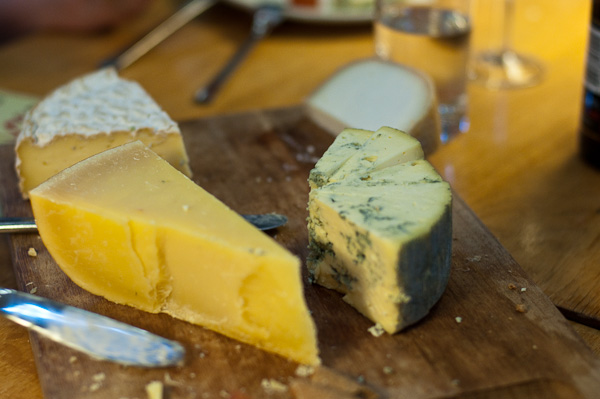
A Selection of Irish Cheeses

This is the first of a two-part round-up of this year’s Oxford Symposium on Food and Cookery which took place from July 9-11, 2010 at St. Catherine’s College, Oxford.

The weather was unseasonably warm and I was glad the College Bar — why don’t American colleges have official bars? It’s so civilized — opened at 6PM on Friday evening providing a refreshing Gin and Tonic. Not long after, our first meal began with a glass of German Sekt and some Prosciutto di Parma in the garden as Chef Raymond Blanc announced the winners of this year’s Young Chef’s Grant who got to help prepare Friday evening’s dinner along side Chef Jeremy Lee of London’s Blue Print Cafe. Congratulations to winners Max Barber, Elaine Mahon and Daniel Penn.
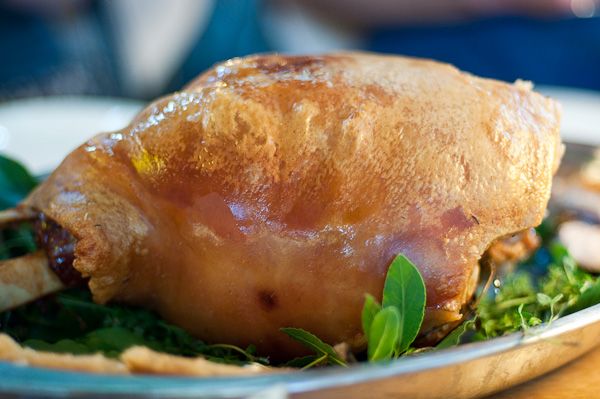
Baked, Salted, Middle White Pork

To kick off the weekend Mr. Lee conceived a Feast of Cockaigne, the imaginary land of Medieval legend, where there is always plenty of food and drink and no one has to work very hard.

In keeping with the theme most of the courses contained foods which had been preserved. Here’s the menu:

Salt cod, vegetables, and aioli

Baked salted Middle White Pork from Huntsham Court Farm, Herefordshire, UK
with abraised green beans with a green sauce.

Almond meringue with berries and whipped cream, sometimes also called Eaton Mess.

The meal was accompanied by the following Spanish red wines:
Ribera del Duero Crianza 2006
Ribera del Duero Reserva 2005

On Saturday afternoon after fascinating plenary talks by food scientist Harold McGee and anthropologist Sidney Mintz and some papers about ancient Roman fish sauce. I was ready for lunch.

Bang Bang Chicken

Lucky for me, it was provided by renowned Chinese food expert Fuchsia Dunlop and the chefs from London’s Barshu Restaurant where she is a menu consultant.

The Chinese are known for their prodigious use of fermentation (thousand year eggs anyone?) and lunch did not disappoint:

First Course

Bang Bang Chicken
Sweet and Sour Spare Ribs
Spicy Cucumber Salad
Refreshing Green Soybeans.

Second Course

Gong Bao Chicken with Peanuts
Bear’s Paw Beancurd
Choy Sam with Fragrant Oil
Steamed Rice

The wine was a 2008 Riesling Trocken “Kraut wine,” weingut tesch from the Nahe wine region in Germany.

And so it was back to the intellectually stimulating portion of the program. During the afternoon I attended presentations about a fermented bread from Transylvania which is purposely cooked in such a hot oven that the outside layer turns to charcoal; the history of eastern European Jewish pickled foods in Canada; and Ken Albala’s inspiring talk on the “Missing Terroir Factor in Historic Cookery.” His new book is right at the top of my to-buy list.

Part Two of this summary of Oxford 2010 will go up next week. See you then.
Read Full Post »

Photo by MPerel

When you visit Oxford you are surrounded by history of all types. Some of the colleges were founded in the 13th Century, and their famous alumni are too numerous to count, stretching across all imaginable professions including historians, chemists, writers, explorers, politicians and more. One quite pleasurable way to make a connection with some of these denizens of the past is to visit their old stomping grounds for a pint or two.

There are quite a number of very old pubs in Oxford, some dating from the 15th Century. With the resurgence of Real Ale, the selection of drink at most pubs has greatly improved over the last 20 years or so. Look for the hand pumped taps to try some local specialties.

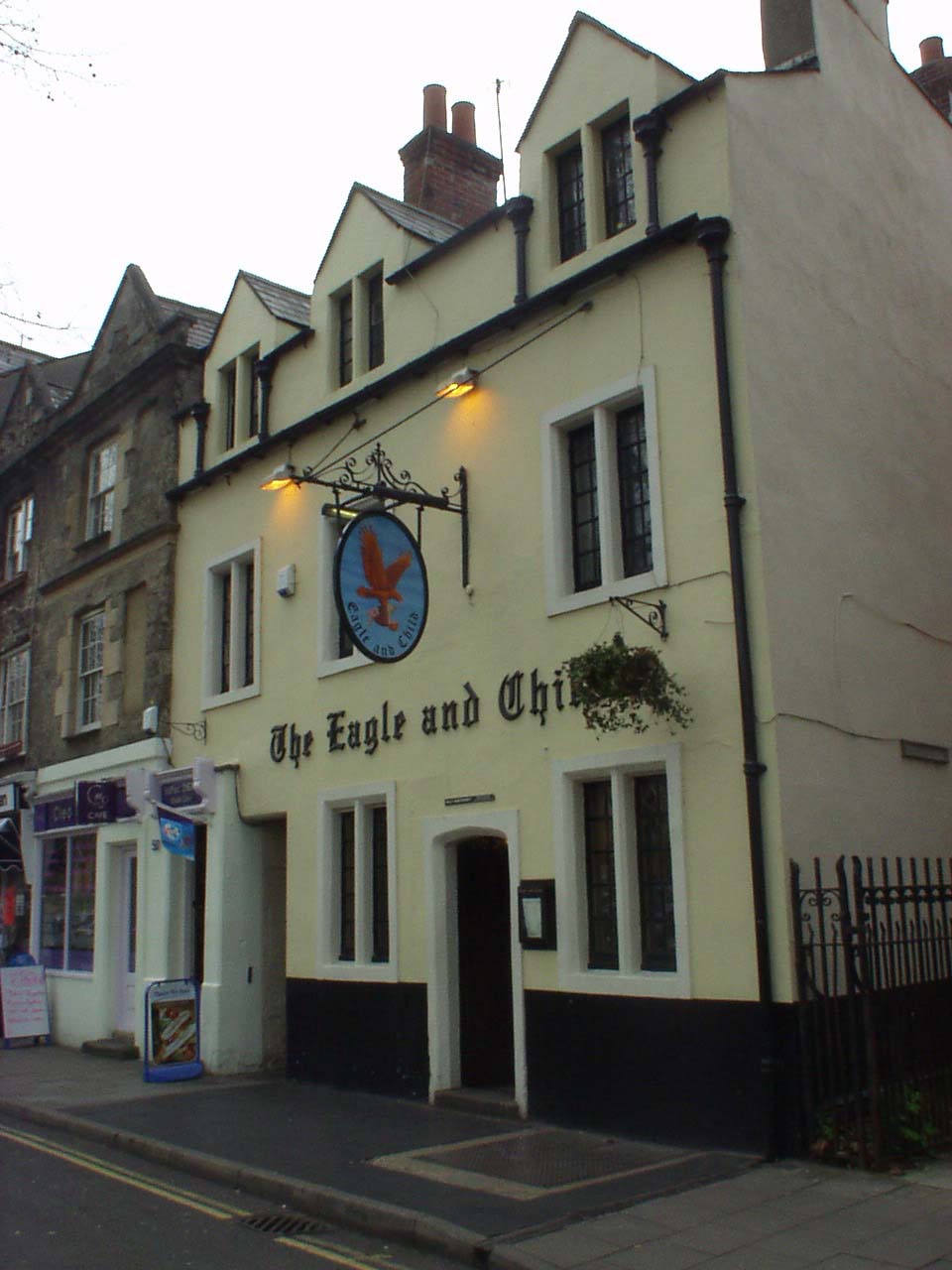
When I come to Oxford for the Symposium on Food and Cookery, I always try to visit a couple of pubs I haven’t been to before. This year I tried out the Eagle and Child which is in a building built in the 16th Century and became a pub in approximately 1650.

Notably, the Eagle and Child is associated with several writers who studied and/or taught at Oxford, including J.R.R. Tolkien, C.S. Lewis. They were part of a group called the Inklings which met from about 1933-1963 at Lewis’s rooms at Magdalen College to read aloud unfinished works. The group also had a standing lunch date on Tuesday afternoons at the Eagle and Child (or the Bird and Baby as they liked to call it). They would sit in the then back room (the pub has since been extended in the rear), known as the Rabbit Room.

The name of the pub is supposedly derived from the eagle and child on the coat of arms of the Earl of Derby. However, the Earl’s lands are in Lancashire and there is also a pub called the Eagle and Child there which used to lie on the Earl’s estate, so who knows?

Legend has it that one of the Earls of Derby back in the 14th Century had not succeeded in fathering a male heir (he and his wife had one daughter). Trying to ensure the continuation of his line, he had a dalliance with a noblewoman whom he kept in style nearby. This liaison resulted in the birth of a bastard son. The Earl then arranged to have his son “found” in an eagle’s nest dressed in clothing appropriate to a noble child. The story of a child found in an eagle’s nest is common to several mythologies of ancient Europe including Norway and France, so perhaps this is where the Earl got the idea. In any case, his wife agreed to adopt the child and raise it as their son and heir.

While sipping my pint, I got to wondering if Mr. Tolkien created the giant eagle that rescues Galdalf from Sarumon’s tower in The Lord of The Rings on a Tuesday afternoon while drinking at the Eagle and Child.

Read Full Post »

Photo by Erik Forsberg

Just a quick note from the Oxford Symposium on Food and Cookery. As this year’s theme was Cured, Fermented and Smoked Foods, I got to try lots of unusual preparations from around the world, the most striking of which was Swedish surströmming.

Food science maven Harold McGee spoke about it in his Plenary presentation titled “A Chemical Introduction to Cured, Fermented and Smoked Foods.” Surströmming is made from herring that is caught in the spring, the heads are chopped off, but the guts are left in. The fish are then packed in a barrel with salt which is put in the sun for several months. It is then re-packed into unsterilized cans and aged for six months to a year. Fermentation continues in the cans and sometimes they bulge.

To those of us (including me) whose mothers taught us never to buy a bulging can from the supermarket, this all sounded rather terrifying. However, it is important to note there are many types of bacteria, some of which are helpful to us humans allowing us to make cheeses, pickles, sauerkraut, and other cherished foods . In many fermentation processes, the “good” bacteria create an acidic environment where “bad” bacteria (like botulism) cannot survive. A Japanese laboratory analyzed some of the cans used for making surströmming and found and important (non-harmful) bacteria on their surfaces which contributes to the fermentation process. In other words, if the cans had been sterilized, the process may not have worked properly.

In concluding his presentation on the science of fermentation, Mr. McGee quoted Alan Davidson, one of the founders of the Oxford Symposium, who had actually gone to Sweden to observe the opening of the surströmming barrels and the transfer of the partially fermented fish into cans:

As the smell billowed upwards, birds began to drop dead from the sky.

During Saturday’s tea break we all got a chance to try some of this pungent concoction served with pieces of soft Swedish tunnbröd. The can was opened outdoors due to the odiferous nature of this traditional food. Considering that they only opened one small can and you could smell it about half a block away, I’d say this was a good decision.

When I ventured outside to see what was going on, I was struck by a very strong earthy, loamy odor which reminded me of durian. Surprisingly, it did not smell fishy. I got up my courage and tried some. The flavor was not fishy either, it was very ammoniated like a cheese that has been allowed to ripen too long. One of my fellow tasters commented that if there was such a thing as fish cheese, it would taste like surströmming.

I don’t know that I’ll be rushing out to buy some, but it was not nearly has bad as I thought it would be. In another part of his presentation, Harold McGee told us that scientists have recently discovered that the brain can differentiate between smells that enter only through the nose and those that go from the mouth to the nose. The brain treats these differently, so sometimes something that smells revolting can taste pretty good.

Perhaps the moral of the story is that your parents were right to say that you should at least try everything.

Read Full Post »

Fermented Salted Eggs in Hong Kong / Photo by Flickr user Tracy Hunter

The highlight of my food history year is coming up this weekend. I’ll be attending the Oxford Symposium on Food and Cookery in the UK. This annual gathering of food historians includes both professionals and enthusiastic amateurs and focuses on a specific theme. This year we’ll be exploring cured, fermented, and smoked foods. These are some of the most ancient techniques for preserving food and are used all over the world. Some of the papers to be given at the symposium include: “Sausages of the Classical World” by historian Joan Alcock, “Rotten vegetable stalks, stinking beancurd and other Shaoxing delicacies” by Chinese food expert Fuchsia Dunlop, and “Smoke and Mirrors? Montreal smoked meat and the creation of a tradition” by Alan Nash who specializes in the geography of food.

Aside from all of this intellectual stimulation, as you might expect, there is lots of good food. On Friday evening we will be treated to a Feast of Cockaigne by chef Jeremy Lee of the Blueprint Cafe in London. For this menu, Mr. Lee imagines the kinds of food which might be served in the mythical land of Cockaigne where no one has to work very hard, and luxurious food is just an arms-length away (think Big Rock Candy Mountain).

Saturday’s lunch is a Sichuan meal brought to us by the chefs at London’s Barshu Restaurant where the aforementioned Fuchsia Dunlop is a consultant. Having cooked several dishes from her superb cookbooks, I’m really looking forward to this one.

On Saturday night Pádraic Óg Gallagher of Gallagher’s Boxty House in Dublin will ply us with traditional Irish foods using first class artisanal ingredients.

Finally, our lunch on Sunday will be particularly historic as the ingredients will reach us by sailing ship! A Dutch company has decided to go back to the old ways and is providing sustainable transport using sail power to ship goods around the world. The Brigantine “Tres Hombres” is one of their ships and it will be used to send traditional Norwegian foods to the symposium, which will then be transformed into a buffet for us by Ove and Svein Fossa from the Norwegian branch of the Slow Food Movement.

After the symposium, I’ll be spending a little time in Oxford, trying out some local Real Ale and poking about in libraries. Then it’s off to London for some research on another project. I’ll be posting short notes from the road when I have Internet access, and I’ll do a more detailed round up of the Oxford Symposium when I get home.

Read Full Post »