Feeds:
Posts
Comments

Archive for February, 2010

This article is part of a series of recipes suitable for the Medieval season of Lent during which all animal products other than fish were forbidden except on Sundays. I’ll be posting at least one Lenten recipe per week until Easter Sunday (April 4, 2010).

Asian cuisine is a tremendous source of Lenten dishes. There are many fish-based and vegetarian delights to choose from. These recipes often contain no dairy, or what there is can easily be replaced with olive or other oils. Best of all, this food is flavorful and exotic so you don’t feel like you’re denying yourself. In fact if you save these dishes especially for Lent, it can feel like a celebration.

Lately I have been infatuated with Fuchsia Dunlop’s magnificent Chinese cookbooks. Today’s recipe is a savory, spicy (but not too hot) fish dish from Sichuan province. It does require some specialty ingredients, but if you live near a chinatown this can be easily accomplished. There are also good mail order sources for much of what is needed (see recipe below for details).
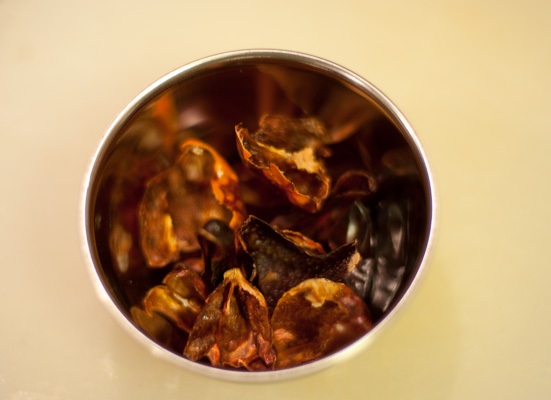
Facing-heaven chiles, waiting to go into the wok

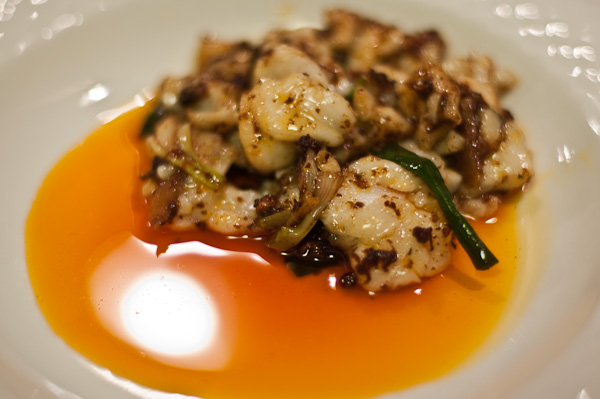
Don’t be intimidated by the bright red oil that drenches the fish. It’s purpose is to stimulate your senses with it’s deep color and spicy, almost floral fragrance, you are not expected to eat it. Take the fish out of of the oil with your chopsticks, leaving most of it behind on the plate, along with the whole spices which have also already done their job.

If you haven’t eaten Sichuan food before, know that while it is spicy, it is not as fire engine-hot as you might expect. One of the most important ingredients is Sichuan pepper which is not at all spicy, but instead causes a physical sensation of numbness and tingling in the mouth. It is very sensuous and pleasant, and really makes this cuisine special.

Fish with Chiles and Sichuan Pepper

adapted from Fuchsia Dunlop

Serves 2 as a main dish if served with a vegetable side dish and rice

Notes on specialized ingredients:
If you live in New York City, see my previous article about shopping for sichuan ingredients in Chinatown. There are also photos there of whole facing-heaven chiles and Sichuan pepper so you’ll know what to look for. Unfortunately, I have not found a good mail order source for the facing-heaven chiles so if you don’t live near a chinatown you may need to substitute. I have read that pequin chiles can be used, but the flavor is not the same. Beware, if you use the long skinny Thai chiles (also called bird’s eye chiles), they are much hotter than Sichuanese chiles so you should use less.

I can highly recommend the Sichuan pepper available via mail order from Adriana’s Caravan, it is very fresh and flavorful. They also carry the chili bean paste, which they call Chili Bean (Toban Djan) Sauce. When shopping for this item try to get a version made with fava or broad beans instead of soy beans.

1 pound filet of carp, sea bass, or other white-fleshed fish

For the Marinade
a 1-inch piece of fresh, unpeeled ginger, crushed
1 scallion, both white and green parts cut into 3-4 pieces and crushed
½ teaspoon salt
2 teaspoons Shaoxing rice wine or dry sherry
4 tablespoons cornstarch
3 tablespoons cold water

For the Base Flavorings
6 dried Sichuanese chiles (facing-heaven chiles)
1 1-inch piece of ginger, peeled and thinly sliced
3 cloves of garlic, peeled and thinly sliced
5 scallions both the white and green parts, cut into 2-3 inch pieces and crushed
3 tablespoons of peanut or corn oil
1 tablespoon Sichuanese chili bean paste
1/2 teaspoon whole Sichuan pepper

For the Spicy Oil
¾ cup peanut or corn oil
1½ tablespoons Sichuanese chili bean paste
1-2 ounces dried Sichuanese chiles (facing-heaven chiles)
2 teaspoons whole Sichuan pepper

It is important to measure and chop all of your ingredients before beginning this dish. Once you start cooking it goes very quickly, so have everything prepped in small containers and ready to go.

Marinate the fish: lay your fish fillet on a cutting board and cut it into ¼-½ inch thick slices by holding your knife almost parallel to the cutting board and making very shallow cuts. Put the slices in a small bowl and add the salt, wine or sherry, ginger, and scallion, and toss gently with your fingers. Let stand while preparing the rest of your ingredients.

Snip all of your dried chiles in half with scissors and shake out as many seeds as possible. If you have sensitive skin you may want to wear gloves. In any case, wash your hands thoroughly with soap after handling the chiles and be careful about touching your eyes.

Cook the base flavorings: heat 3 tablespoons of oil in a wok over a high flame. When it begins to smoke, turn the heat down and add the chile bean paste and stir-fry until the oil is red and fragrant. Add the ginger, garlic, scallions, dried chiles, and Sichuan pepper and continue to stir-fry until it is very fragrant and the scallions are tender. Keep an eye on the temperature, you want the oil sizzling but not so hot that it will burn the spices. Pour the contents of the wok into a deep serving bowl.

Cook the fish: bring a medium saucepan full of water to a boil over high heat. Meanwhile, discard the ginger and scallion from the fish marinade. Mix the cornstarch and cold water to form a thin paste. pour the paste over the fish slices and toss gently with your fingers until all of the slices are well coated. When your water is boiling, drop all of your fish slices into the pot. DO NOT stir until the water has returned to a boil or the coating will come off. Allow the water to come back to a boil and cook the fish slices until they are just done and nicely flaky (about 5 minutes). Use a slotted spoon or skimmer to remove the fish slices from the pot and put them in the serving bowl on top of the base flavors.

Make the spicy oil: Quickly heat ¾ cup of oil in the wok over a high flame until it begins to smoke. Turn down the heat a little and add the chili bean paste and stir-fry until the oil is red and fragrant. Add the remaining chiles and whole Sichuan pepper and stir-fry until they are crisp and fragrant, the longer you go, the spicier it gets. The oil should be sizzling but not so hot as to burn the spices. When it is ready, pour the hot oil and spices over the fish in the serving bowl and serve immediately while it is still bubbling.

Read Full Post »

The other day one of my favorite food writers, Michael Ruhlman, began musing on Twitter about why he cooks. He then wrote a blog post about it and encouraged others to follow suit. Here are my thoughts.

Cooking is a magical window onto other cultures. In particular, for me it is a window onto the past. As L.P. Hartley once wrote, “The past is a foreign country: they do things differently there.” Cooking is a way of traveling through time and space without leaving the confines of my kitchen.

I remember a foggy morning in France, when a friend and I were standing, tickets in hand, waiting for the gates of a chateau to open. There was a vendor selling fresh, hot croissants so we bought some and had just started eating them when the guard came along with his big set of jangly keys. As he collected our tickets and waved us through into the gardens, he didn’t say bonjour or merci, instead he said, “bon appetit!” It was at that instant I truly understood the place of food in the French heart. I haven’t made croissants myself (yet!), but when I do, I’ll be brought right back to that moment.

Cooking is a time machine. Cooking and eating historic dishes is way to get inside the heads of people who lived well before I was born. What better way to imagine what it was like living in the Massachusetts Bay Colony in the 17th Century than by cooking up a pot of Baked Beans? Until I researched and cooked that recipe, I didn’t know the dish was crafted so a Puritan housewife could put it in the ashes of the fire on Saturday night, eliminating the need for cooking on the Sabbath. That’s one of the reasons the recipe contains molasses, it’s an acid which prevents the beans from becoming mushy over the course of their long slow bake.

In October, 2009 a friend generously gave me some some pig offal left over from her meat CSA. I went straight to Madeleine Kamman and her recipe for Grosse Cochonnailles or Coarse Country Pâté. Before World War II, at that same exact time of year, French villagers in Brittany would slaughter their pigs and make a myriad of dishes using every bit. I didn’t have a whole pig but, I got a chance to peep into that world by making the pâté and cooking Fergus Henderson’s Pot-Roast Half Pig’s Head.

Until those geniuses at MIT and Stanford figure out how to make a real time machine, I’ll be here cooking my way through history. I read recently, that we have some 4,000 year old cuneiform tablets with recipes on them from Mesopotamia, how cool is that? Ancient land of Ur, here I come.

Read Full Post »

Photo by Janne Hellsten

I’ll admit it’s difficult to eat seasonally in the Northeastern US or Northern Europe in winter. You must cultivate a love for root vegetables and make the acquaintance of farmers with large green houses. But just imagine if your religion required you to give up most animal products during that same time. For Medieval Christians that’s exactly what was expected.

Lent is a period during which Christians traditionally practice fasting and prayer, and give alms to the poor. The period begins on Ash Wednesday (which is today this year) and lasts for the 40 days leading up to Easter Sunday. I love learning about history through food, so a few years ago I did some reading about this tradition. It turns out that fasting in late-winter/early-spring is actually a pre-christian activity. If you think about the way the subsistence farming of that era worked it makes a lot of sense.

Lent is derived from the Anglo-Saxon word “lencten,” which means “spring,” and begins about one month before the Vernal Equinox. This is a time when even if you were forward-thinking like The Ant, you may be starting to run low on all of the provisions you dried, salted away and pickled during the abundance of harvest time. The English call this time “hungry gap,” the new crops aren’t growing yet; the ewes haven’t given birth; the cow, if you didn’t slaughter her for meat in the autumn, might be dry; the hens are laying much less frequently due to the weak winter sun; and the community still needs to eat.

I would imagine that ancient religious and political leaders quickly realized that if they didn’t do something to help their people get through this thin time, they would have food riots on their hands. So, they encouraged sacrifice for the greater good of the community. If people ate fewer animal products at the end of winter, there would be enough to go around until the asparagus was up and the lambs were dropped.

Nowadays of course, many of us (in the First World) don’t have to worry about not having enough food. On the one hand that’s wonderful because subsistence farming is back-breaking work, but on the other, our new abundance seems to have led to an epidemic of obesity in affluent countries. For the last few years I’ve been keeping the Medieval rules of Lent as a way of reminding myself that more is not always better.

The original rules of Lent, which observant Christians had to comply with on pain of Mortal Sin, forbade the consumption of meat (including poultry), animal fats, milk, or eggs from Ash Wednesday to Easter except Sundays. Yes, you read that right, except Sundays. The Church considers Sundays feast days so fasting or abstinence is not allowed. Leaving out Sundays is also how you get the figure of 40 days, if they are included then it adds up to 46. The modern church has eased these rules encouraging instead voluntary fasting and abstinence which it defines as eating one full meal per day and omitting meat and poultry on Ash Wednesday and all Fridays.

The first year we tried this in our house it was a little difficult to adjust. The ancients were wise to have it begin on a Wednesday, so you’ve only got four days to go before Sunday in that first week. After a while it becomes easier, it’s basically a vegan diet plus fish. Most cultures that are traditionally Christian have lenten recipes, if you look in Italian, Greek and Spanish cookbooks you’ll find things that either fit the rules or can be easily adapted. Most Asian cuisines are terrific too because they don’t use dairy. Some might see coconut milk as cheating, but boy is it tasty.

On the upside, you always remember to celebrate Mardi Gras or Shrove Tuesday; you really appreciate the meat, eggs, cheese, and butter you get to have on Sundays; and you might even lose a little weight. In particular, I find Lent a welcome respite from the holiday season, which while it technically runs from about Thanksgiving to New Year’s seems to stretch ever further with rich roasts and braises to combat the winter weather. By the end of Lent I’m dreaming of asparagus and fresh spring flowers.

For the next six weeks on Comestibles I’ll be featuring at least one lenten recipe per week. If you’d like an early start check out this very comprehensive list from blogger Peter Minakis. His recipes are geared towards the Greek Orthodox version of Lent which is very similar to the western Catholic Medieval tradition, except that fish is forbidden while shellfish is not. I’ll definitely be trying out some of these dishes this year.

Read Full Post »

No matter where you live or what you call it, the object of the last day before Lent is the same: eat as much of the soon-to-be-forbidden foods as you can before it’s too late. Lent, which begins this year on Wednesday, February 17th, is a 40 day season during which Christians traditionally fast, pray, and give alms to the poor. In the Medieval period, observant Christians were forbidden meat, milk, eggs and animal fats during Lent. The modern Catholic church has eased these rules, encouraging voluntary fasting and abstinence. This is defined as eating only one full meal per day (or two small ones which add up to less than one full meal), and the omission of meat and poultry on Ash Wednesday (the first day of Lent), and all the Fridays in Lent. It has also become traditional for people to give up something they particularly enjoy for the 40 day period, although that is not an official church policy.

As you might imagine, the Medieval rules led to lots of serious eating during the days leading up to Lent. Aside from having one last taste of your favorites, you needed to use up all the eggs, milk, and animal fats in the house. In the days before refrigeration, using up the meat was not as much of an issue because it was only acquired right before it was to be eaten, so most households didn’t have a lot lying around.

In particular the very last day before Lent is a great excuse for wild parties; in Iceland they call it Sprengidagur which means Bursting Day; the French name for it is Mardi Gras or Fat Tuesday; in Sweden it is Fettisdagen; in Estonia, Vastlapäev; in Spain, Martes de Carnaval; in the Czech Republic, Masopust, which means “goodbye to meat,” and in German, Faschingsdienstag. In English-speaking countries it is known as Shrove Tuesday, Pancake Tuesday, or simply Pancake Day. The word “shrove” comes from the archaic verb “to shrive” which means to obtain absolution for your sins. It was important to be shriven before the beginning of Lent as it is a season of penance.

Even though the rules are no longer as stringent, this religious tradition has left us with some wonderful seasonal foods. Since their purpose was to use up all of the non-lenten ingredients in the house, they have some things in common. They are often fried and they are very rich, containing eggs, milk, butter, and if a creative cook can manage it, some meat thrown in for good measure.

In Portugal they make Malasada which is a fried dough; the Polish enjoy their Paczki or jelly doughnuts; in Sweden you would be eating Semla, a pastry spiced with cardamom, filled with almond paste and whipped cream, and served in a bowl of hot milk; in Croatia, which was part of Venice for hundreds of years, they eat Fritule which are fritters enhanced with brandy and lemon zest; and the denizens of the Czech Republic say “farewell to meat” by holding large pork feasts during the time leading up to Lent.

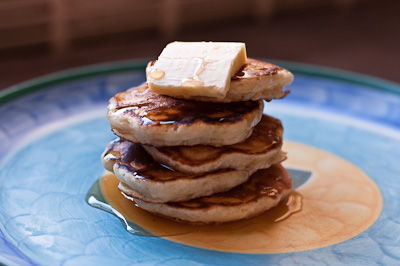
In English-speaking countries the traditional Shrove Tuesday meal is pancakes, they can be made either savory or sweet and are a great way to use up eggs, milk, butter and other fats. Traditionally in Britain they were served with a rich meat stew. In some places slices of sausages or other meat are mixed right into the pancake batter. Try out the recipe below and imagine, if you will, Medieval British cooks flipping their pancakes while keeping one ear cocked to hear the the ringing of the shriving bell or pancake bell which reminded them to use up all their fats and come to church to be shriven.

Pancakes

Adapted from The Joy of Cooking

Makes about 14 four inch pancakes

1½ cups all purpose flour
1 teaspoon salt
3 tablespoons sugar
1¾ teaspoons baking powder
2 eggs, separated
3 tablespoons melted butter
1¼ cups milk, or buttermilk

Stir together the dry ingredients with a fork. In a separate bowl, beat the egg yolks and the milk or buttermilk together, then stir in the melted butter.

Pour the eggs and milk into the bowl with the dry ingredients and stir only enough to just wet all the dry ingredients, don’t beat too much; you want it to look lumpy. It should be thick but still pour fairly easily off a spoon. If it is too thick add a bit more milk or buttermilk and if it is too thin add more flour.

Whip the egg whites until they form stiff peaks and then fold them lightly into the batter, taking care to deflate them as little as possible.

If you cook the pancakes on a non-stick surface you won’t need any butter. If you use a regular pan then use just a little butter to keep them from sticking.

Heat the pan over medium-high heat until water splutters when a few drops are sprinkled on it.

Use a large spoon to transfer the batter to the pan. Don’t drop it from way up high, just let it pour from the tip of the spoon onto the pan, this will help control the pancake shape. Once you have formed the pancake let it cook for 2-3 minutes or until most, but not all, of the bubbles which form on the uncooked side have burst. Then flip the pancake and cook the other side for 1-2 minutes or until nicely browned.

Break open your first pancake to see if the inside is cooked properly and adjust the heat under your pan accordingly, then continue making pancakes until all the batter is used up.

To keep the pancakes warm before serving, keep them on a plate in a warm oven separated by clean kitchen towels. Without the towels between them they will steam each other and lose their nice texture. You can prepare a stack of folded kitchen towels in advance and put on pancake in each layer.

Read Full Post »

Photo by Flickr user ageing accozzaglia

Remember restaurants back in the early 1990s when just as you picked up your fork to tuck into that seared Ahi tuna, the waiter would approach wielding a giant pepper grinder? “Would you like some fresh pepper?” he would ask, barging in on your hedonistic revelry.

Those out-sized pepper mills were not invented in 1990, in fact they were a feature of Parisian bistrôts in the 1950s and probably earlier. But in Paris no waiter worth his er … salt would interrupt the sensual communion between diner and plate. If you wanted some pepper you could ask for it. “Excusez-moi, monseiur? Le Rubirosa, s’il vous plait?”

“Rubirosa?” Isn’t “pepper mill” in French “moulin à poivre?”

Well, yes, and no.

Especially on Valentine’s Day, you might earn an extra smile from your French waiter if you ask for the Rubirosa. The sparkling jet-set of French society in the 1950s named the largest pepper mill in the house after Porfirio Rubirosa. A man who some might say was the original Latin Lover and was certainly the last of a dying breed, the international playboy.

In his 56 years he managed to marry 5 women (two of whom were billionaire heiresses), win polo tournaments on 3 continents, drive his Ferrari to victory in Formula 1 races, and take hundreds of lovers including Christina Onasis, Zsa Zsa Gabor, Eartha Kitt, Eva Peron, Gene Tierney, Veronica Lake, Ava Gardner, Rita Hayworth, and Kim Novak, just to name a few. Oh, and did I mention he was a jewel thief?

A native of the Dominican Republic, Rubirosa began his career as an aide-de-camp to Rafael Trujillo. In that position he had unusual access to the dictator’s daughter. Flor de Oro. If Rubirosa had been the proverbial “man in the grey flannel suit,” then angling for the boss’s daughter might have been considered a good move. However, if the “boss” is one of the 20th Century’s most vicious dictators, it’s a good way to get yourself killed. In the first of many examples of his infinite capacity to charm, Rubirosa was allowed to marry Flor in 1932. They were transferred into the foreign service and posted to Europe.

Rubirosa was one of those people who always seemed to be in the right place at the right time. On a diplomatic mission in Germany he sat in Hitler’s box at the 1936 olympics; he represented his country at the coronation of George VI; during World War II he was in Paris, Vichy, Belgium, and the Netherlands. While in Europe he met the French movie star Danielle Darrieux, who became his second wife. Amazingly, Trujillo did not have Rubirosa killed for divorcing his daughter. Legend has it, they fought like cats and dogs and when Trujillo asked about this, Rubirosa defended the right of a Dominican man to beat his wife. In fact, Trujillo called Rubirosa “an excellent diplomat because women adore him and he’s a liar.”

After the war the Generalissimo sent him to Buenos Aires where he stayed during the Peron years and allegedly took Eva Perón as a lover. He was also in Havana during the fall of cuba to Castro. When Trujillo was assassinated in 1961 Rubirosa became a liason between the post-Trujillo government and the Kennedy administration.

At some point, he must have found himself in need of money. The jet-set lifestyle takes a lot to maintain, what with the polo ponies, the bespoke suits, and the Ferrari. So he divorced Danielle Darrieux and married one of the richest women in the world at the time, Doris Duke, heiress to billions (in today’s dollars) through her father’s tobacco company. He divorced her after about a year and a half, coming away with $25,000 a year in alimony (about 200,000 in today’s dollars).

It was after this he began his famous affair with actress Zsa Zsa Gabor. The courtship was like something out of a romance novel. He met her in a hotel elevator, invited her out, she said no, being already engaged. That very evening he moved into the suite next door and filled her room with roses. But their relationship was contentious. She refused to leave her husband George Sanders and marry him. During an argument about it, Rubirosa struck her. The next day she held a press conference at which she arrived wearing an eye patch. The headline in the New York Daily News read: “I said No, So Porfy Poked Me: Zsa Zsa” In some ways, they were perfect for each other, but it was not to be.

Rubirosa and Zsa Zsa Gabor

Next Rubirosa set his sights on Barbara Hutton, who as heiress to both the Woolworth and E.F. Hutton fortunes, was the richest women in the world at the time. They stayed married for 73 days and he got about $3.5 million for it which is about 27 million in today’s money. His last and longest marriage was to a 19-year-old French actress named Odile Rodin. Some say they were a very good match because she was almost as lascivious as he was; constantly out with her numerous lovers at glamorous night clubs, she may have actually succeeded at making Rubirosa jealous.

He died the way he had lived. In the early hours of July 6, 1965, after a night of partying in celebration of his latest polo championship he wrapped his silver Ferrari around a tree in the Bois de Boulogne in Paris.

So how did he do it? He never had much money (of his own), it’s not like he was some European nobleman who had fallen on hard times; there were plenty of those around at the time. He did not climb particularly high in the diplomatic corps, most of his jobs were ahem, ceremonial. He spoke five languages and was always impeccably dressed, but there were others like that. What was Rubi’s secret? Well, remember that pepper grinder in the French bistrôt? It seems that Mr. Rubirosa’s chief attribute was one of endowment.

Cuban composer Eduardo Saborit wrote a song about him called “Que Es Lo Tuyo, Rubirosa” or “What Have You Got, Rubirosa.” Which had the following lyric: “Rubirosa has a thing/and I don’t know what it is/What could it be/ What could it be?/Rubirosa’s thing.” According to Rubirosa’s biographer, Shawn Levy, “when that moment in the song was sung, men on the dance floor would grab their pants around their knees, indicating a physical endowment that you couldn’t talk about out loud then, but which was legendary.” In his unfinished, tell-all, non-fiction novel Answered Prayers, Truman Capote describes Rubirosa’s best asset as “an 11-inch café au lait sinker as thick as a man’s wrist.” Rubi’s ex-wife, Doris Duke, told her godson, “It was six inches in circumference, much like the last foot of a Louisville Slugger baseball bat.”

Famously, Hugh Hefner calls New Year’s Eve “amateur hour” and usually stays at home. I feel the same way about Valentine’s Day. Who needs a special holiday to take your beloved out for a hot night on the town? For Rubi, every day was Valentine’s Day and so should it be for all of us. So wait for an evening when you won’t be overcharged for insipid food, make a reservation at the most glamorous place in town and don’t forget to ask for the Rubirosa.

Read Full Post »

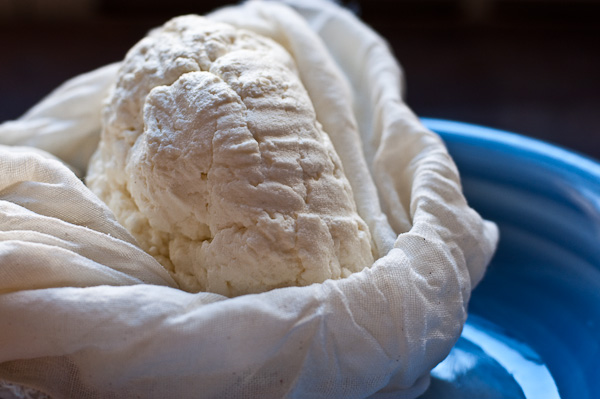
Making ricotta is sort of like getting into the union. You must already have a union job before you can get into the union and in order to make true ricotta you must already have made some cheese. Real ricotta is a dairy product (technically it is not a cheese) made from whey. Whey is a byproduct of cheese making; in particular, ricotta is made from the whey left over after making pecorino, an Italian sheep’s milk cheese.

To make true ricotta, the fresh whey is left to stand for 12-24 hours which increases its acidity. It is then heated to a temperature very close to boiling. This causes any remaining protein to coagulate into very fine curds which are skimmed off, drained through some cheese cloth, and allowed to cool.

We don’t really know how long people have been recycling left over whey into a secondary product. Some argue that it is mentioned by Cato the Elder in his De Agri Cultura which was written around 160 BCE. Others claim that the Arabs brought the technique to Europe when they conquered Sicily in the 10th Century.

As usual, our ancestors knew a good thing when they saw it. Whey is packed with important nutrients including protein and riboflavin (vitamin B2). In fact, the Vikings used to drink whey and use it for pickling fish and vegetables. Its acid nature makes it a great pickling agent. Other uses for whey include: replacing the water in any bread recipe, or buttermilk in other baking recipes; feeding it to farm animals, pigs in particular, love it; seasoned with spices it can be used to marinate meat; or pour it on your garden as a fertilizer. Modern dairies often send their whey to be dehydrated and used as a component in the various protein powders favored by body builders.

Even if you don’t have your cheese maker’s union card, you can still make ricotta (or something similar) at home. You just need good whole cow’s milk, salt and citric acid. Citric acid is a crystalline substance that looks a lot like sugar, but tastes like a thousand lemons. If you’ve ever tasted Sour Patch Kids or other super sour candies, you’ll recognize the flavor. Citric acid is sometimes called “sour salt” and can be easily purchased in stores which specialize in Indian ingredients because it is used to make paneer. You can also mail order it from a cheese making supply company. I have seen other recipes for ricotta which use lemon juice or vinegar as the acid component, but I think it’s easier to get the dosage just right with citric acid.

Whole Milk Ricotta
adapted from Ricki Carroll

Makes about ¾ – 1 pound of ricotta

Several pieces of equipment are important for this recipe. You must have a properly calibrated thermometer to measure the temperature of the milk. Test your thermometer by putting it in rapidly boiling water to see if it reads 212F.

You will also need a small fine mesh strainer, no bigger than about 2-3 inches in diameter. This is used to remove the curds from the pot. You can also use a skimmer or perforated ladle, but make sure the holes are not too big.

Finally, you need good quality cheese cloth. If you can get what is called “butter muslin” from a cheese making supply company you will only need one layer. If you use the cheese cloth sold in most supermarkets, use at least 3 layers because it is not woven as tightly.

½ gallon whole milk
½ teaspoon citric acid
¼ cup cool water
½ teaspoon kosher salt

Mix the water and citric acid together in a small bowl and stir until the powder is completely dissolved.

Pour your milk into a large and very clean pot. Add the citric acid solution and the salt to the milk and stir well. Put the pot of milk over a medium-low heat and slowly bring it up to a temperature between 185 and 195 degrees F. Do not allow it to boil. Stir often with a rubber spatula, scraping the bottom to prevent scorching.

You will see the curds begin to form, they are very tiny, perhaps the size of poppy or sesame seeds. After a while the curds will separate from the whey and you will see patches of greenish-yellow whey in the pot. When the curds and whey are completely separated, the whey will not look milky. You can see this by dipping a spoon in and pouring the liquid back into the pot, as it comes off the spoon you’ll be able to see if the whey looks milky or if the liquid is more clear in between the particles of curd.

One the curds and whey have separated, turn off the heat and leave the pot to stand for 10 minutes.

Prepare a strainer or colander by lining it with butter muslin or cheese cloth (see note above) and set it over a large bowl.

Use your small fine mesh strainer or skimmer to gently ladle the curds out of the pot and into the lined strainer. Use slow motions so as not to stir up the curds. When you have ladled as much of the curd out as you can then pour the remaining whey through your strainer or ladle and into another bowl to get the last bit of curd. Don’t discard the whey.

Tie the corners of your butter muslin or cheese cloth into a knot and hang the ricotta over a bowl to drain for 45 minutes to an hour or until it stops dripping. An easy way to set this up is by sliding a chopstick behind the handle of one kitchen cabinet door, through the knot in the butter muslin and then behind handle of the adjacent cabinet door. Then place a bowl on the counter below to catch the draining whey. Just be sure the knot is tight enough to hold the weight. You can also tie the cheese cloth to the faucet in your sink and hang it there with a bowl beneath.

Save the left over whey! You can’t make any more ricotta out of it but it has many uses (see above). I recently used it instead of buttermilk in pancakes to great acclaim.

When the ricotta is finished draining, unwrap and eat! Or use it to make ravioli, eggplant rollatini, lasagna, or cheesecake. If you would like a creamier consistency, you can add a couple of tablespoons of cream and mix thoroughly. It is also makes a stellar breakfast with a little honey drizzled on top. It will keep in a covered container in the refrigerator for 1-2 weeks.

Read Full Post »

SCENE: rural 19th Century England. You stride into a country pub after an invigorating day of grouse hunting, slap your hand on the ancient wooden bar and say, “Landlord, a pint of your finest ale, if you please.”

Oh, pardon me, I was just reading some Sherlock Holmes, which got me daydreaming about tweed, the dark wood interior of the local public house, and of course, beer. Happily, you can live out almost all of this fantasy today. There are many fine country pubs to be found in England that have not changed much since the 19th Century (or earlier). The person behind the bar is still called the landlord or occasionally the landlady. However, until fairly recently, your chances of being served the same kind of beer as you would have been two hundred years ago, were slim to none.

The pint of ale Mr. Holmes quaffed while squeezing the Landlord for facts concerning his latest investigation, would have been pumped up by hand, from a cask or firkin in the pub’s cellar and served at a temperature around 54 degrees F. Its frothy head was the result of gentle, naturally occurring carbonation created by the living yeast that were still in the cask. It would have had a complex aroma, soft mouth feel, and rich, multi-layered flavor. Beer in those days was more like wine, continuously evolving until the moment it was served.

Let’s compare that to the way beer is served in a bar today — a method which began in the mid-1930s and became ubiquitous by the 1950s. The beer is still pumped up from the cellar, however, it’s stored in a keg instead of a cask and the pump is electric is powered by gases like carbon dioxide and nitrogen, which also carbonates the beer. Before being put in the keg at the brewery, the beer is likely filtered to remove the yeast, and/or pasteurized, which kills any remaining yeast and sterilizes the beer extending its shelf life. Removal or killing of the yeast freezes the flavor development of the beer at that moment, it will no longer evolve. Pasteurization (which is basically cooking the beer) changes the flavor drastically, removing some of the more complex flavors and imparting a burnt sugar taste. There is also no natural carbonation in this beer; you need yeast for that. The brewery provides artificial carbonation by pressurizing the keg with carbon dioxide or a mixture of nitrogen and carbon dioxide and further carbonation is also added by the tap system itself. The beer is also served very cold, which is partially accounted for by modern — in particular, American — tastes, but it also hides the fact that these beers don’t really have much flavor compared to their cask cousins from long ago. When something is ice cold, you can’t really taste it.

Do not despair, gentle reader, it is still possible to taste the past. To find out how, I sat down — over some beers, of course — with Alex Hall, “Cask Ale Consultant,” and Mary Izett, certified Beer Judge, and friend. Hall works for U.K Brewing Supplies, an importer of casks and other equipment necessary for bars to serve cask beers and Izett judges homebrew competitions in the tri-state area and writes for Ale Street News.

Cask beer is what Mr. Holmes was drinking back there in the 19th Century and is defined by Hall and Izett as, “unfiltered, unpasteurized beer brewed from only traditional ingredients, matured and naturally carbonated by a secondary fermentation in the container from which it is manually dispensed, i.e., served without the use of nitrogen or extraneous carbon dioxide. It is ideally served at cellar temperature (54F), cool, but not chilled.” Hall describes cask beer as tasting, “funky, more complex, less bubbly, and richer; it has tiny bubbles vs. the big nasty, angry bubbles in keg beer.” Over the last 30 years or so a movement has grown, beginning with the Campaign for Real Ale in England, advocating the return of cask beer. In the last decade, with the help of people like Mr. Hall, it has reached American shores.

When asked why brewers would tamper with a perfectly good product and destroy some of its best attributes in the process, Hall replied that, “keg beer stays fresher longer, and it’s a lot easier to handle than casks.” Once a cask is tapped it must be finished within about 48 hours or it will go off, whereas kegs last 45-60 days. Hall also said that by using kegs brewers prevent losses due to the return of “bad” casks that were actually just mishandled by incompetent barmen. “With casks the barman must be skilled, knowing how to vent them, and allow them to settle. Some cask beers require “fining” [the addition of natural clarifying agents] after they arrive from the brewery. The pub landlord used to be trained in this, but those skills have been lost. With kegs, it’s child’s play, when it’s empty, just plug in another one, anyone can do it.”

Lucky for us New Yorkers, Hall has been evangelizing about cask beer since he arrived here from the UK in 1999. When asked about the best way to try out this delectable beverage he recommended attending a cask ale festival. “It’s the best way to try out many beers. Festivals are very big in the UK,” he said, ” they vary from vast annual events, to small, casual ones in pubs where as few as a dozen — but more often two or three times that number — unusual firkins are thrown up on tables or on temporary [racks].” He organized the first cask ale festival in New York City in 2003 at the Brazen Head in Brooklyn. It was so popular, the bar now holds them three times a year. The next one is this coming weekend. It runs from Friday, February 5 through Sunday, February 7 from 12PM until late each day. Over 30 casks will be available over the course of the festival, with 12 being open at any given time. No cover or minimum.

If you can’t make it to the Brazen Head this weekend, Hall also maintains a website called The Gotham Imbiber where you can download a PDF listing over 50 bars in New York City that have at least one cask beer available at all times. Outside of New York, ask at your favorite craft beer bar about cask beer, the beer geeks will know if there is any around. If you’re lucky enough to travel to the UK, get hold of the Good Beer Guide, to find the best pubs to visit.

Now, if you’ll excuse me, I believe I hear Dr. Watson calling.

Read Full Post »

Stories make the best condiments. Just think of how many times you’ve tucked into a favorite dish with friends or family and commenced reminiscing about past eating experiences. Maybe it’s the one your uncle Howie tells about the neighborhood bakery that made the best bagels and phenomenal seeded rye and sadly closed down years ago, with nothing opening since that holds a candle to it. Or perhaps you’ve heard that bagels were invented in 1683 when bakers in Vienna celebrated the Polish King Jan Sobieski‘s victory over the Turks by creating a roll in the shape of his stirrup, (German for stirrup is “bügel“). And then there’s the tale that purports to explain why real bagels are boiled before they’re baked. Church leaders in medieval Poland wouldn’t allow Christians to buy any food from Jews, unless it was boiled.

One of the tastiest, and maybe even true, yarns I’ve discovered about bagels recently is the origin of the confederation of Thai bagel rollers found in the best bagel shops in New York these days. If you go into any number of reputable bagelries, where everything, including the shaping of the bagels, is still done by hand, you may be surprised to learn that the toothsome, crusty, chewy delight you’re about to sink your teeth into was created by a person originally from Thailand.

Milton Parker, the owner of the Carnegie Deli, writes in his history of the restaurant, How to Feed Friends and Influence People, that in the 1990s when there was a lot of money sloshing around in Thailand, the government decided it would be a good idea to teach bagel-making to some of its citizens. So it contacted some retired members of the International Bagel Bakers Union Local 338 in New York City and invited them to Thailand. As with many brilliant ideas conceived during boom times, the bagel never really took off in rice-centric Thailand. But, some of those Thai bagel men, and their sons emigrated to the New York and easily found jobs in the better bagel shops.

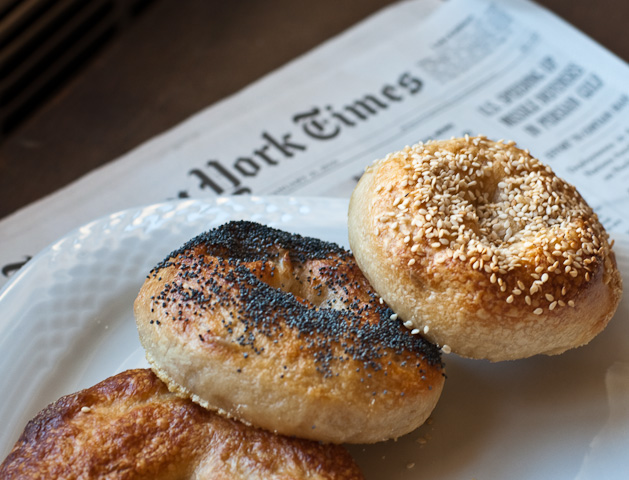
After recently making bagels at home for the first time, I can tell you that the rolling of the bagel is an important component. Some of mine came out looking very authentic and others, well, let’s just say I need a little practice. But I didn’t care how they looked because they had that snappy crust and chewy interior praised by all bagel lovers. Best of all, I can report that making bagels isn’t any harder than baking bread. It is time consuming but bagels freeze exceedingly well, so make a big batch and fill up your freezer. If you live in a part of the world where it’s difficult to get real bagels (as opposed to rolls with holes), this recipe could be a life saver.

Bagels

Adapted from Peter Reinhart

Modern bagels weigh in at a hefty 7 oz. while historically, they were much smaller (2-3 oz.). This recipe makes about 12 modern size bagels or 18-24 2-3 oz. bagels). I recommend weighing out your pieces of dough so they are all the same size and will cook evenly.

This recipe takes two days to make because the dough is “retarded” overnight in the refrigerator to develop flavor. If you’re in a hurry you can make it without that step, but the bagels won’t be as flavorful.

Please read the recipe all the way through before making your shopping list as there are separate ingredient lists for some steps.

Day 1

Make the Sponge

1 teaspoon instant yeast
4 cups unbleached bread flour or other high gluten flour
2½ cups water, room temperature

In a 4 quart mixing bowl, use a fork to thoroughly stir the yeast into the flour and then add the water and stir with a spoon until it makes a thick sticky batter. Cover with plastic and leave at room temperature until the batter has doubled in size and is quite bubbly (about 2 hours). It may take longer if your kitchen is chilly.

Make the Dough

Malt is a very important ingredient for this recipe as it gives the authentic bagel flavor. Malt syrup is usually sold in health food stores as an alternative sweetener. I was not able to find malt powder, but have heard that some Whole Foods outlets carry it.

½ teaspoon instant yeast
3¾ cups unbleached bread flour or other high gluten flour
2¾ teaspoons salt
2 teaspoons malt powder or 1 tablespoon of malt syrup, honey, or brown sugar

In the bowl of a stand mixer, stir the additional yeast into the sponge and then add 3 cups of the flour, all of the salt and the malt, and mix on low speed with the dough hook until the ingredients are well combined and form a ball. Then, slowly work in the remaining 3/4 cup of flour to form a stiff dough. You can do all of this by hand, with a spoon but it is a very stiff dough so be prepared for a serious workout.

Turn the dough out onto a clean surface and knead for 10-15 minutes. When finished kneading the dough should pass the “window pane” test and should read 77-81 degrees F on a thermometer. If you haven’t used the “window pane test” before, here’s a great video explaining it. If your window pane is still tearing after 10-15 minutes of kneading, add a few drops of water and knead a little more. If your dough is very sticky, add a tiny bit of flour and knead some more. Baking depends very much on the current weather conditions, especially the humidity, so these little adjustments may be needed.

Divide your dough into pieces of the weight you would like your bagels to be. I made 18 3 oz. bagels from this recipe. Form each piece into a roll by stretching down the “sides” of each piece and pinching the dough together in a seam at the “bottom.” Place the rolls, seam down, on a clean surface, cover them with a damp kitchen towel, and let them rest for 20 minutes.

Line 2 sheet pans with baking parchment and spray them lightly with a neutral spray oil (I actually used olive oil because it’s all I had around and it didn’t seem to affect the flavor).

Shape the bagels by using your thumb to poke a hole through the center of your roll and then carefully rotate your thumb, gently stretching the dough around it into an even, doughnut shape. For my 3 oz. bagels I made holes that were about 1 3/4 – 2 inches in diameter, for larger bagels the holes would be larger. When you first stretch the dough it may bounce back. Keep working with it until the hole remains the size you want after you put it down.

Put each shaped bagel on the prepared sheet pans, about 1 1/2 inches away from its neighbors. Mist the bagels lightly with spray oil, wrap the pans in plastic and let them rest at room temperature for about 20 minutes.

Next we check to see if the bagels are ready for their overnight rest in the fridge. Fill a small bowl with room temperature water. Carefully take one bagel and drop it in the bowl. If the bagel floats within 10 seconds, it is ready. If not, then pat it dry, return it to the pan, wrap up the pan and give them another 10 or 15 minutes before testing again.

Once a bagel passes the float test, pat it dry, return it to the pan, wrap up the pan and place the pans in the refrigerator over night or for up to 2 days.

Day 2

Mr. Reinhart’s recipe calls for putting baking soda in the boiling water. Another story I’ve been told about bagels is that the real secret ingredient is New York City water which happens to be a lot softer than much of the water in the US. I’m guessing that Mr. Reinhart has you add baking soda to imitate this softness. I left it out since I am lucky enough to have AOC New York City water coming right out of my tap.

cornmeal
1 tablespoon baking soda (optional)
Bagel toppings: sesame seeds, poppy seeds, kosher salt, etc. (optional)

Preheat your oven to 500 F and put two racks in the center.

Bring a large wide mouthed pot of water to boil on top of your stove. Add the baking soda if using.

Remove the bagels from the refrigerator and drop them gently into the boiling water. Do not crowd the pan, only put in as many as will fit comfortably. Boil the bagels for 2 minutes and flip them over and boil them for another 2 minutes. While the bagels are boiling, sprinkle cornmeal on the same parchment lined pans, this will help prevent the bagels from sticking. When the bagels are boiled, remove them from the water with a slotted spoon or skimmer and place them back in the cornmeal sprinkled pans.

If you are going to top your bagels, do it immediately after they are removed from the water, or the toppings will not stick.

Repeat until all bagels are boiled and topped.

Bake in the center of your oven for 5 minutes, then lower the temperature to 450 F. (Note: I actually forgot to lower the temperature, and it didn’t seem cause any harm). Bake for an additional 10-15 minutes or until the bagels are a dark golden brown. Partway through the baking rotate the pans, swapping racks and also turning them 180 degrees.

Cool on racks for about 15 minutes and serve with the traditional accompaniments of cream cheese (just a schmear), Nova, Gravlax, red onion, capers, whitefish, etc.

Read Full Post »